
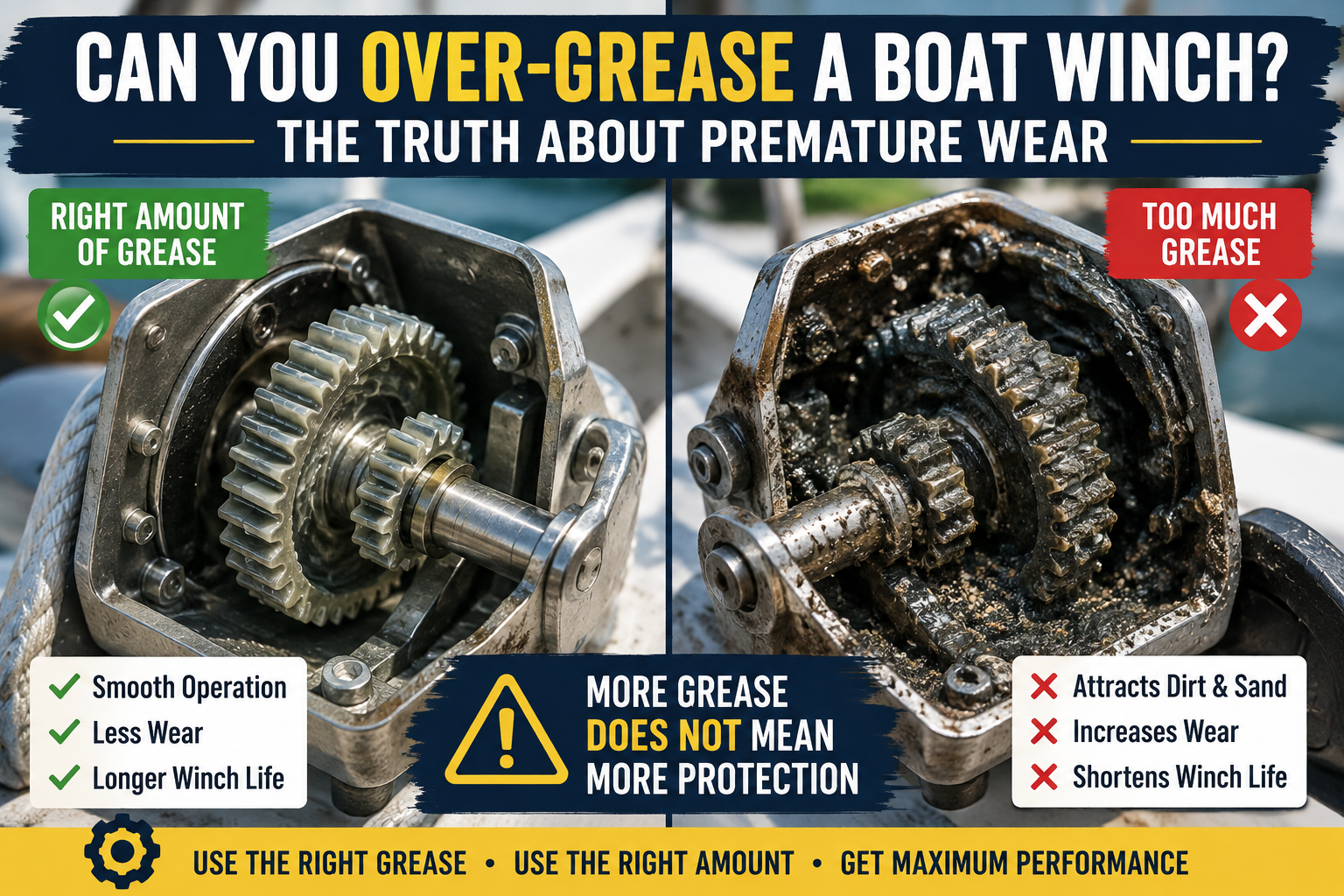
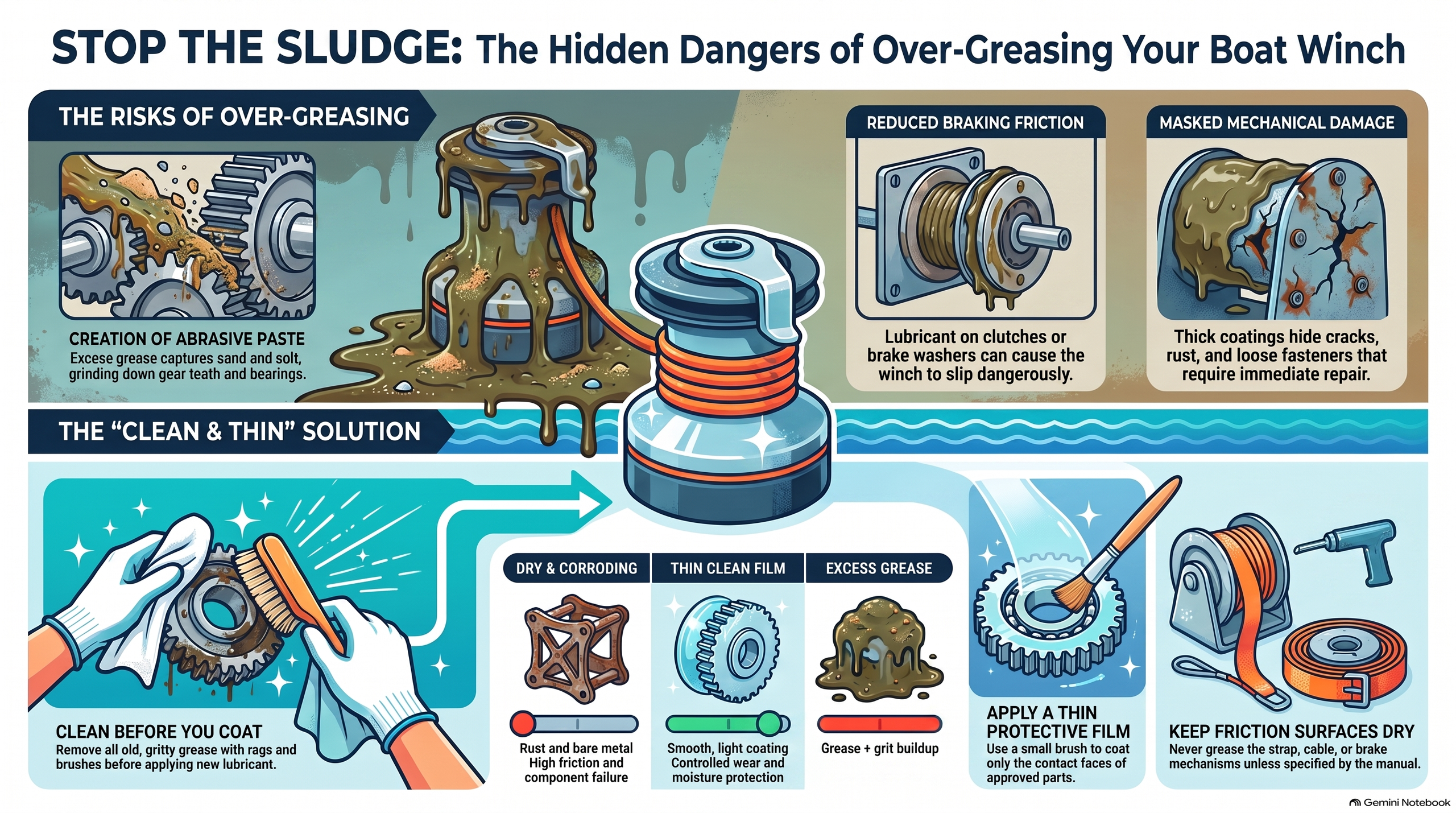
Over-greasing a boat trailer winch can contribute to premature wear, but the problem is usually not the grease alone. Excess lubricant creates a sticky surface that captures sand, salt, dust, and metal particles. Once worked into gears, bushings, shafts, or bearings, that mixture can behave like an abrasive paste.
Fresh grease also cannot clean a contaminated mechanism. Applying more lubricant over gritty or corroded grease traps the debris against moving surfaces and may hide damage that needs repair.
The correct goal is not a visibly full housing. It is a clean, compatible, thin protective film on the components designed to be lubricated.
DRY AND CORRODING       THIN CLEAN PROTECTIVE FILM       EXCESS GREASE HOLDING GRIT
     [metal]                    [metal]                         [metal]
       rust                     smooth film                   grease + sand + salt
       friction                  controlled wear               abrasive paste
What over-greasing can damage
A small amount of suitable marine grease can reduce friction and protect metal from moisture. Too much can create several different problems:
- Contamination: Grease attracts dirt, sand, and salt, particularly around an exposed drum, gear cover, or shaft.
- Abrasive wear: Contaminated grease can grind against gear teeth, bushings, bearings, and shafts as the winch operates.
- Grease migration: Excess lubricant may spread onto the strap, rope, or cable and then transfer to other parts.
- Reduced braking or holding friction: Grease on a clutch, brake washer, pawl, ratchet, or drag surface can cause slipping if that surface is designed to operate dry.
- Hidden corrosion or damage: A thick coating can make pitting, cracked housings, damaged teeth, and loose fasteners harder to inspect.
- Leakage and mess: Excess grease can squeeze out of joints, collect on the trailer, or migrate toward the strap path.
Over-greasing is therefore both a quantity problem and a contamination or compatibility problem. A thin, even film on a clean gear tooth is fundamentally different from packing a gearbox or coating every internal part.
The required amount depends on the winch design and the manufacturer’s instructions. Manual winches, electric winches, self-braking models, and winches with clutches or drag mechanisms may have different lubrication points. Some sealed assemblies are not intended to be opened or serviced by the owner.
Before lubricating the winch
Read the service section of the winch manual before removing a cover or applying lubricant. Confirm:
- Which components require grease
- Whether the winch has a brake, clutch, drag, or free-spool mechanism
- Whether the assembly is sealed
- Which grease type and quantity the manufacturer specifies
- Which components must remain dry
- Whether the strap, rope, or cable requires any specific treatment
Use a marine-rated grease that matches the specification. Do not assume that all marine greases are interchangeable. Different grease bases, thickeners, and additives may not perform well together, and mixing products can change the lubricant’s consistency or protective properties.
Prepare a stable, well-lit work area. Secure the trailer and boat according to the manufacturer’s instructions, and do not rely on the winch alone to support the boat. For an electric winch, disconnect power when appropriate before working near the mechanism. Wear gloves and eye protection, and have clean lint-free rags, a small brush, and suitable hand tools available.
If disassembly may be required, photograph the winch first. Record the position of covers, washers, fasteners, and the strap or cable. These photographs can help identify incorrect reassembly later.
Component-by-component lubrication procedure
1. Identify the design and approved lubrication points
Locate the gear teeth, bushings, bearings, shafts, grease fittings, and covers. Then identify the brake, clutch, pawl, ratchet, or drag components.
Do not use a generic procedure for a specialized winch. For example, if the manual specifies grease on the gear teeth and shaft bushings only, that does not authorize grease on a clutch disc or brake washer.
Some winches have sealed gear assemblies that should not be opened or filled with additional lubricant. If the manual does not identify an owner-serviceable lubrication point, inspect the unit externally and seek the manufacturer’s guidance rather than forcing grease into a seam or fitting.
2. Secure and unload the winch
Reduce or release winch tension before working near the drum, gears, strap, or cable whenever the manufacturer’s procedure permits. Keep the boat independently secured and supported.
A manual winch should not be serviced while it is carrying the boat’s full load. An electric winch should be disconnected from its power source when the inspection could expose moving or energized components.
Relieving tension also makes it easier to detect rough rotation, strap misalignment, damaged cable, and abnormal drum movement without load forces masking the problem.
3. Inspect before cleaning
Inspect the winch before covering anything with fresh grease. Look for:
- Rust or salt deposits
- Pitted gear teeth
- Cracked or distorted housings
- Loose fasteners
- Rough shaft or handle rotation
- Worn bushings or bearings
- Frayed cable or damaged strap
- Twisted or misaligned strap
- Grease around the strap path
- Water or corrosion inside the housing
Examine the old grease. Clean, smooth grease may indicate normal service, although it still must be evaluated against the maintenance schedule. Gritty, milky, watery, metallic, rusty, or salt-crusted grease indicates contamination, water intrusion, corrosion, or component wear.
If the handle feels rough with the winch unloaded, do not try to correct the sensation by adding more grease. The roughness may come from damaged gears, worn bushings, corroded shafts, a misaligned cover, or an over-tightened fastener.
4. Remove contaminated grease
Wipe away old grease with clean rags. Use a small brush to work debris out of accessible gear teeth, grooves, and shaft areas. Use only cleaning products that are compatible with the winch’s materials, seals, painted surfaces, and the manufacturer’s instructions.
Keep removed grease and cleaning materials away from the strap, cable, brake surfaces, boat finish, and trailer components that should remain dry. Do not allow solvent or dirty grease to run into an electric motor or other sealed electrical component.
Allow cleaned parts to dry as directed before lubricating them. If sand is visible around a drum hub, remove the old grease and sand completely before applying a new film. Brushing fresh grease over the sand only embeds the abrasive material more securely.
Clean the exterior with fresh water when appropriate after salt-water exposure, but avoid forcing water into sealed housings, electrical components, bearings, or other areas where water intrusion could cause damage. Dry the winch before storage or lubrication.
5. Apply a thin film to approved parts
Apply the specified marine grease only to approved moving surfaces. Depending on the design, these may include:
- Gear teeth
- Gear shafts
- Bushings
- Bearings
- Pivot points
- Other metal-to-metal contact points identified by the manual
The lubricant should form a thin, continuous coating over the contact surface. It should not fill every cavity or ooze from every joint.
A small brush, cotton swab, or gloved fingertip usually gives better control than forcing a large amount from a grease gun. Coat gear teeth enough to cover the working faces visibly, then rotate the mechanism by hand if permitted so the film distributes across the contact surfaces.
If the winch has a grease fitting, follow the specified quantity or indication. Stop when the manual says to stop. Do not continue pumping until grease emerges from covers, seals, or unrelated joints.
Keep grease away from:
- The strap or rope
- The cable, unless the manufacturer specifies a compatible treatment
- Brake and clutch friction surfaces
- Pawls, ratchets, or drag surfaces that must engage without lubricant
- Any area specifically marked “do not grease”
A strap or cable contaminated with grease can slip, collect abrasive debris, or become difficult to inspect. Grease on a brake or clutch can reduce the friction needed to hold the load. The exact mechanism varies, so the manual’s instructions take priority.
6. Reassemble, remove excess, and test
Replace covers, seals, washers, and fasteners in their original positions. Tighten fasteners according to the manufacturer’s procedure; excessive tightening can cause binding, while loose hardware can allow misalignment or water entry.
Wipe away grease squeezed from joints or exposed around the drum. Visible excess is not evidence of better protection.
Operate the winch without a load first. Check for:
- Smooth rotation
- Abnormal noise
- Binding
- Slipping
- Irregular handle resistance
- Correct brake or clutch engagement
- Correct free-spool operation, if equipped
- Grease moving toward the strap or cable
After several unloaded turns, inspect the strap path. If the strap picks up grease, stop using the winch until the contamination is removed and the migration path is identified. The cause may be an overfilled housing, a displaced seal, a misaligned drum, or grease applied to the wrong area.
7. Record the service and monitor the result
Record the service date, lubricant used, components serviced, and any corrosion or wear found. Note whether the old grease was clean, gritty, metallic, or water-contaminated.
Reinspect the winch after salt-water launching, heavy rain, exposure to sand or debris, and prolonged storage. Follow the manufacturer’s service interval rather than adding grease automatically. A repeatedly gritty condition may indicate a missing seal, water intrusion, or an environment that requires more frequent cleaning.
Troubleshooting lubrication-related problems
e winch still feels rough after greasing
Remove excess lubricant and inspect the grease for sand or metal particles. Check the gears, bushings, bearings, shafts, covers, and fasteners. Roughness can indicate mechanical wear or incorrect reassembly rather than insufficient lubrication.The winch slips or will not hold
Stop using it until the holding system is inspected. Check the brake, clutch, pawl, ratchet, strap, cable, and load-support arrangement. Grease on a friction surface may be a cause, but the brake or clutch may also be worn, damaged, or incorrectly assembled.
A winch that cannot reliably hold its load should not be returned to service simply because cleaning removes visible grease.
Grease appears on the strap or cable
Clean the contaminated area and identify where the grease is coming from. Inspect the drum, housing, seals, and adjacent shafts. Verify that the housing was not overfilled and that grease is not being forced along the drum by operation.
Do not apply additional lubricant to the strap or cable unless the manufacturer specifically requires it and identifies a compatible product.
The grease is milky, watery, rusty, or salt-crusted
Treat these conditions as evidence of water intrusion or corrosion. Remove the contaminated grease, inspect the internal parts, and correct the source if possible. Repeatedly adding fresh grease can conceal corrosion while leaving abrasive or corrosive material in the mechanism.
The handle binds after reassembly
Check for over-tightened fasteners, incorrectly positioned washers, misaligned covers, damaged bushings, and grease on a part that is intended to move dry. Compare the assembly with the manual or the photographs taken before disassembly.
The winch has serious mechanical damage
Replace or professionally repair components showing damaged teeth, deep pitting, a cracked housing, a frayed cable, or an unreliable brake. Lubricant cannot restore structural strength or correct an overloaded winch.
Maintenance practices that limit premature wear
Use the manufacturer’s lubrication interval and quantity as the starting point, then account for salt exposure, water intrusion, launching debris, frequency of use, and storage conditions. Heavy use does not automatically justify heavy greasing; it may instead require more frequent cleaning and inspection.
Use one approved marine grease consistently unless compatibility with another product has been confirmed. Store the grease container closed and use clean tools so sand and salt do not enter the lubricant.
Keep the strap or cable clean, correctly aligned, and free of grease. Inspect it for fraying, cuts, crushed sections, corrosion, and uneven winding. Check the gears and housing before demanding use, especially after storage or salt-water launching.
A useful maintenance decision checklist is:
- Is this component specified for lubrication?
- Is the surface clean and dry enough to lubricate?
- Is the grease compatible with the existing lubricant and materials?
- Is a thin film sufficient?
- Could grease reduce friction where braking, holding, or clutch engagement is required?
- Can the part be inspected properly after lubrication?
These checks are also part of broader essential boat maintenance practices.
The practical rule is simple: clean first, lubricate only approved contact surfaces, and wipe away what the mechanism does not need. Preventing contamination matters more than maximizing grease quantity.
📅 Last updated: