
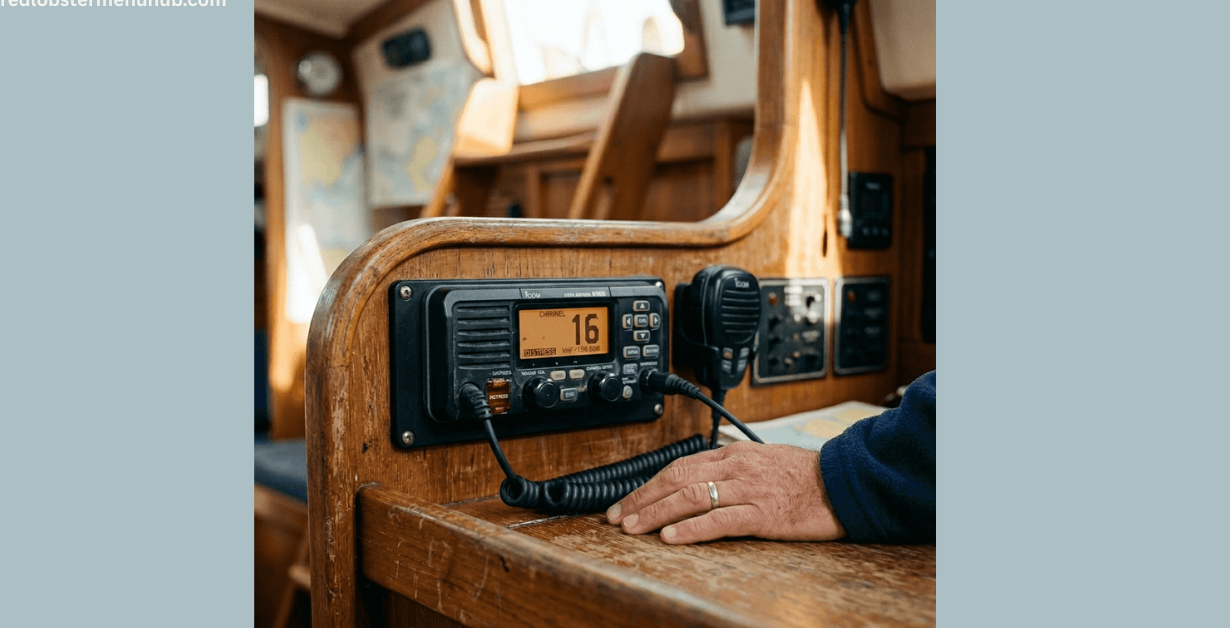
Knowing which VHF channel to use in an emergency can save valuable time. When a boat is taking on water, someone is injured, a person has gone overboard, or you face an immediate threat to life, choosing the correct channel helps alert nearby vessels and rescue authorities quickly.
For most marine emergencies, the answer is
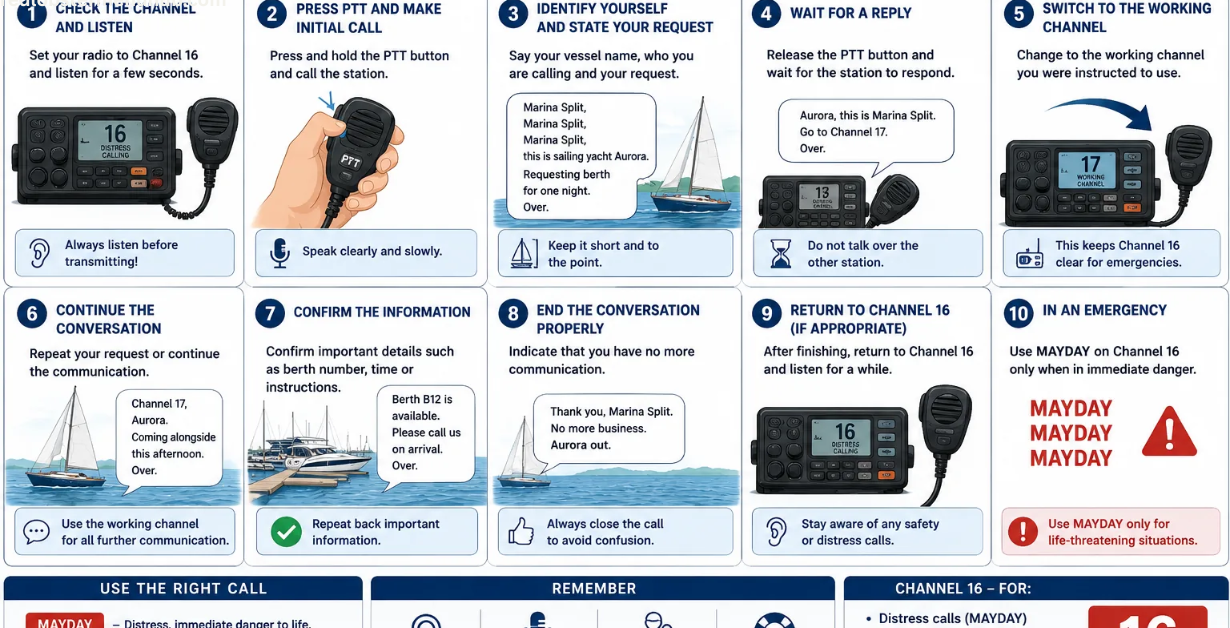
Use VHF Channel 16 for voice distress, urgency, and safety calls.
Channel 16 is the international distress, safety, and calling channel. In areas equipped for Digital Selective Calling, or DSC, you may also send a digital distress alert on Channel 70 before making a voice call on Channel 16.
This guide explains which VHF channel to use, how to make a distress call, and what to do after help responds.
Emergency communication devices are important, but keeping your phone and small electronics charged can also be useful during long trips on the water. For portable backup power options, check out our guide Best Waterproof Power Bank for Boating: What to Look For.
What VHF Channel Should You Use in an Emergency?
Use VHF Channel 16 for a voice emergency call.
Channel 16 operates at 156.800 MHz and is monitored by:
• Coast Guard or maritime rescue authorities
• Commercial vessels
• Recreational boats
• Harbor and marine authorities
• Rescue organizations
• Shore-based radio stations
Channel 16 is used for:
• Distress calls
• Urgency calls
• Safety broadcasts
• Initial calls to another station
• Communications involving immediate safety concerns
After making contact, a rescue authority may instruct you to switch to another channel for continued communication. Follow those instructions and return to Channel 16 only when appropriate.
What Is VHF Channel 70 Used For?
VHF Channel 70 is used for Digital Selective Calling, commonly called DSC. It is not intended for normal voice communication.
A DSC-capable VHF radio can send a digital distress alert that may include:
• Your vessel’s identity
• Your position, if connected to GPS
• The nature of the emergency, if selected
• A signal that alerts compatible stations
After sending a DSC distress alert, make a voice distress call on Channel 16. The digital alert and voice call work together: DSC can quickly notify equipped stations, while the voice call provides details about the emergency.
Do not try to speak on Channel 70. Use Channel 16 for the voice portion of the distress call.
Channel 16: Distress, Urgency, and Safety
Channel 16 is used for three main categories of priority marine communication:
• Distress: A serious and imminent danger requiring immediate assistance
• Urgency: A serious problem that does not yet represent immediate danger to life or the vessel
• Safety: Important navigation or weather information
Each category uses a specific internationally recognized call.
Use “MAYDAY” for a Life-Threatening Emergency
Use MAYDAY when your vessel or someone aboard faces grave and imminent danger and requires immediate assistance.
Examples include:
• The boat is sinking
• A serious fire is out of control
• Someone has suffered a life-threatening injury
• A person is missing or overboard and cannot be recovered
• The vessel is in immediate danger of grounding
• The boat is disabled in hazardous conditions
• You are facing an immediate collision or other grave threat
A MAYDAY call should be made on Channel 16. If your radio supports DSC, send the digital distress alert first when possible, then make the voice call.
How to Make a MAYDAY Call
Speak slowly, clearly, and calmly. Use this general format:
1. Say “MAYDAY” three times.
2. Say “This is” and identify your vessel three times.
3. State your position.
4. Describe the nature of the emergency.
5. State the type of assistance needed.
6. Report the number of people aboard.
7. Provide other important information.
8. Repeat the vessel name and call sign if necessary.
9. End with “Over.”
A basic example is:
MAYDAY, MAYDAY, MAYDAY.
This is vessel Sea Star, Sea Star, Sea Star.
Our position is 3 miles east of Harbor Point at 34 degrees 10 minutes north, 76 degrees 25 minutes west.
We are taking on water and may sink. We need immediate assistance. Four people are aboard. We are in a white 28-foot powerboat.
This is Sea Star. Over.
Use the position format you can state accurately. You may provide latitude and longitude, a distance and direction from a known landmark, a GPS coordinate, or another clear description.
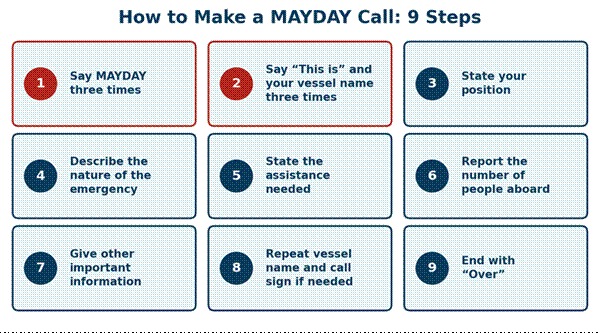
Figure 1: The nine-step format for a VHF MAYDAY call.
What Information Should You Include?
The most important information is your location and the type of help you need.
Try to provide:
• Vessel name
• Position
• Nature of the emergency
• Number of people aboard
• Injuries
• Vessel description
• Current condition of the boat
• Emergency equipment in use
• Intended actions, such as abandoning ship
• Contact information if requested
If you do not know your exact coordinates, give the best available description. You can describe your location using:
• GPS coordinates
• Distance and direction from a buoy
• Distance from a harbor or island
• A known channel marker
• A shoreline landmark
• A charted feature
• Your last known position and direction of travel
Do not delay a distress call simply because you cannot determine your position precisely.
Use “PAN-PAN” for an Urgent Situation
Use PAN-PAN when you have an urgent situation that affects the safety of the vessel or people aboard but does not yet involve immediate grave danger.
Examples may include:
• Engine failure in open water
• A medical problem that is serious but not immediately life-threatening
• Loss of steering
• A disabled boat drifting toward danger
• A navigation equipment failure in difficult conditions
• A person who is overdue or needs assistance, but is not in immediate peril
A PAN-PAN call is also made on Channel 16.
A basic format is:
PAN-PAN, PAN-PAN, PAN-PAN.
All stations, all stations, all stations.
This is vessel Sea Star.
We have lost propulsion 2 miles south of Harbor Point and are drifting toward shallow water. Four people are aboard. We request a tow or assistance. Over.
If a particular station is needed, address that station instead of saying “all stations.”
Do not use MAYDAY for a problem that is inconvenient but not dangerous. However, if conditions worsen and the situation becomes life-threatening, upgrade the call to MAYDAY.
Use “SECURITÉ” for Safety Information
Use SECURITÉ, pronounced approximately “say-cure-ee-tay,” for an important safety broadcast that does not require immediate assistance.
Examples include:
• A drifting navigation hazard
• A large floating object
• A dangerous weather condition
• A disabled vessel that is not in immediate danger
• A missing buoy or damaged marker
• A navigation warning
A SECURITÉ call is normally made on Channel 16 before providing the safety information. The issuing station may then direct listeners to another channel.
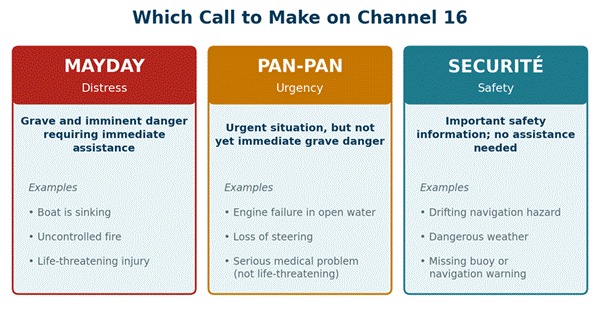
Figure 2: When to use MAYDAY, PAN-PAN, or SECURITÉ on Channel 16.
What Channel Should You Use for a Person Overboard?
For an immediate person-overboard emergency, use Channel 16 to request outside assistance.
At the same time, the crew should begin the boat’s person-overboard procedure:
• Shout the alarm
• Keep visual contact with the person
• Throw flotation equipment
• Mark the position
• Turn the boat safely
• Assign someone to point continuously
• Prepare for recovery
• Contact rescue authorities when necessary
If the person is wearing a personal locator beacon, AIS man-overboard beacon, or other signaling device, activate or use it according to the emergency plan.
A VHF call does not replace the immediate onboard response.
What Channel Should You Use for a Medical Emergency?
Use Channel 16 if a medical condition is serious, life-threatening, or requires urgent outside assistance.
Be prepared to provide:
• Patient’s age, if known
• Symptoms or injury
• Level of consciousness
• Breathing status
• Bleeding or other critical conditions
• Number of patients
• Vessel position
• Whether evacuation is needed
Rescue authorities may transfer you to another channel or connect you with medical assistance. Keep the radio available and follow instructions.
For a minor issue that does not require urgent assistance, use an appropriate working channel or contact a marine service provider. Do not tie up Channel 16 with routine medical questions.
What Channel Should You Use for Engine Failure?
Engine failure does not automatically require a MAYDAY call. The correct call depends on your circumstances.
Use PAN-PAN if:
• You are disabled but not immediately threatened
• You are drifting in open water
• Weather and traffic conditions remain manageable
• You need a tow or technical assistance
Use MAYDAY if:
• You are drifting toward rocks, shoals, surf, or heavy traffic
• Weather conditions are rapidly worsening
• The boat is taking on water
• You cannot maintain control or avoid a collision
• There is an immediate threat to life
Begin on Channel 16 and clearly describe your location, condition, drift, and assistance needed.
Many boat owners rely on shore power and onboard electrical equipment, making safe power connections an important part of boating. Learn what to consider when choosing a durable cord in our guide, Best Marine Extension Cord: How to Choose the Right One for Your Boat.
What Channel Should You Use for Routine Communication?
Channel 16 is not intended for extended conversations. Use it to make an initial call, then move to an appropriate working channel when directed or when the other station responds.
Common working channels vary by country and region, but may include:
• Channel 9 for recreational calling in some US waters
• Channel 13 for bridge-to-bridge or navigational communication
• Channel 22A for certain Coast Guard maritime safety broadcasts in the United States
• Channels 68, 69, 71, or 72 for designated recreational or ship-to-ship communication, depending on local rules
Channel assignments are not universal. Check the channel plan for the country and waterway where you operate.
What Is Channel 22A Used For?
In the United States, Channel 22A is commonly used for Coast Guard marine safety broadcasts after an initial contact on Channel 16. It may be used for information about:
• Safety broadcasts
• Navigation warnings
• Weather
• Search-and-rescue matters
• Maritime safety information
Do not normally make your initial distress call on Channel 22A unless directed to do so. Start on Channel 16 or use DSC Channel 70 followed by a voice call on Channel 16.
The Coast Guard or another authority may instruct you to shift to Channel 22A for additional information.
What Is Channel 13 Used For?
Channel 13 is generally associated with bridge-to-bridge or navigational communication. It may be used for communication involving:
• Vessel maneuvering
• Passing arrangements
• Navigation near bridges
• Commercial traffic
• Safety-related vessel operations
Channel use depends on local rules and the type of waterway. Recreational boaters should not use Channel 13 for casual conversation.
What Is Channel 9 Used For?
In the United States, Channel 9 is designated for recreational calling in many areas. It may be used to establish contact with another recreational vessel or marina before moving to a working channel.
Channel 9 is not a replacement for Channel 16 during a distress emergency. Use Channel 16 when immediate assistance or safety communication is required.
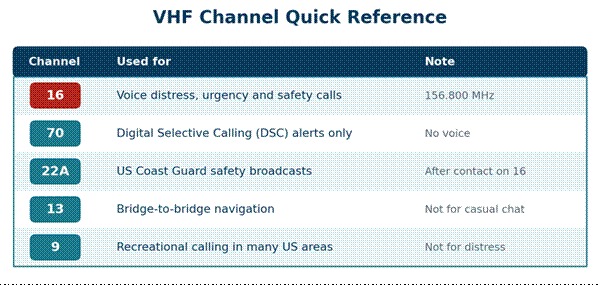
Figure 3: Quick reference for the main VHF channels covered in this guide.
What If Channel 16 Is Busy?
Channel 16 is often busy in high-traffic areas. Listen briefly before transmitting, but do not delay a genuine distress call.
If you hear other traffic:
• Wait for a clear break if the emergency is not immediately life-threatening.
• Transmit over routine traffic if you face imminent danger.
• Clearly say “MAYDAY” to indicate the priority of your call.
• Speak slowly and provide your position first.
• Repeat the call if no one responds.
Rescue authorities and nearby vessels are trained to give priority to distress traffic.
What If You Cannot Reach Anyone?
If no one responds to your first call:
1. Repeat the MAYDAY, PAN-PAN, or safety call.
2. Confirm that the radio is transmitting.
3. Check the volume and squelch.
4. Try the radio’s high-power setting if appropriate.
5. Move to a location with a clearer view of the surrounding area.
6. Use a handheld radio if available.
7. Try another communication method.
8. Activate an EPIRB or PLB if the emergency warrants it.
9. Use flares, lights, signals, or other distress equipment.
10. Continue monitoring Channel 16.
A fixed-mount VHF radio with a properly installed antenna typically has greater range than a handheld radio, but both can be useful.
DSC Distress Alerts
Digital Selective Calling can send a digital distress alert with the press of a button. Depending on the radio’s configuration, the alert may include:
• Maritime Mobile Service Identity, or MMSI
• GPS position
• Nature of distress
• Vessel identification
To use DSC effectively:
• Obtain and program an MMSI where required.
• Connect the radio to the boat’s GPS.
• Register the radio and vessel information.
• Learn how to lift the distress-button cover.
• Read the manufacturer’s instructions.
• Practice the process without transmitting a false alert.
A DSC distress alert is not a substitute for a voice call. After sending the alert, make a MAYDAY call on Channel 16 unless circumstances prevent it.
How Far Can a VHF Emergency Call Reach?
VHF marine radios generally operate by line of sight. Range depends on:
• Antenna height
• Transmit power
• Radio condition
• Antenna condition
• Boat position
• Terrain
• Weather and interference
• Whether you use a fixed or handheld radio
A fixed-mount VHF with a high antenna may reach much farther than a handheld unit. Do not assume that a low-power handheld radio can contact a distant station.
If you are operating offshore or in remote areas, carry additional communication and distress equipment appropriate to the voyage.
VHF Emergency Calling Tips
Follow these practices to improve the chance that your call will be understood:
• Keep the radio accessible.
• Monitor Channel 16 when required or appropriate.
• Keep the radio volume high enough to hear responses.
• Speak slowly and clearly.
• State your position early.
• Use plain language when necessary.
• Repeat critical information.
• Avoid unnecessary background noise.
• Keep the microphone close to your mouth.
• Use the correct power setting.
• Maintain a charged handheld radio battery.
• Keep the fixed radio connected to GPS.
• Check the antenna and coaxial cable regularly.
In an emergency, clarity is more important than perfect radio phraseology.
Common VHF Emergency Mistakes
Using the wrong channel
Do not make an initial voice distress call on a recreational working channel. Use Channel 16.
Speaking on Channel 70
Channel 70 is for DSC data, not voice communication.
Delaying the call
Do not wait until the boat is already sinking or the emergency becomes impossible to manage. Call when it becomes clear that outside help may be needed.
Giving an incomplete position
A rescue authority needs your location before it can send help. Use GPS coordinates or a clear description based on known landmarks.
Failing to state the type of emergency
Explain whether you are sinking, on fire, disabled, taking on water, or dealing with a medical emergency.
Using MAYDAY for a routine request
Reserve MAYDAY for grave and imminent danger. Use PAN-PAN for urgent but not immediately life-threatening situations.
Forgetting to monitor for a response
After transmitting, listen carefully and keep the radio available.
Using Channel 16 for a long conversation
Make the initial call, then move to the assigned working channel when directed.
Not programming the MMSI.
A DSC radio may not provide the full benefit of digital distress calling if the MMSI is missing or the GPS is not connected.
Frequently Asked Questions
What VHF channel do I use for an emergency?
Use VHF Channel 16 for a voice distress, urgency, or safety call. If your radio supports DSC, send a digital alert on Channel 70 first when appropriate, then make the voice call on Channel 16.
Is Channel 22A an emergency channel?
Channel 22A is used for certain Coast Guard marine safety communications in the United States. It is not generally the channel for your initial voice distress call. Start on Channel 16 unless directed otherwise.
What is VHF Channel 70 used for?
Channel 70 is reserved for Digital Selective Calling. It is used to send digital alerts and is not used for ordinary voice communication.
What does MAYDAY mean on a marine radio?
MAYDAY indicates a grave and imminent danger requiring immediate assistance, such as sinking, uncontrolled fire, or a life-threatening medical emergency.
What does PAN-PAN mean?
PAN-PAN indicates an urgent situation that affects the safety of a vessel or person but does not yet involve immediate grave danger.
Should I use Channel 16 for a minor boat problem?
Use Channel 16 for emergencies and initial safety-related calls. For a minor, non-urgent issue, use an appropriate working channel or contact a marina or marine service provider.
Staying connected on the water can involve more than emergency beacons alone. If you want better internet access while boating, see our guide, Best Boat Wi-Fi Extender: How to Improve Internet on the Water, for practical tips on extending wireless coverage.
Final Thoughts
For most boating emergencies, VHF Channel 16 is the channel to use for a voice call. If your radio has Digital Selective Calling, use Channel 70 to send the digital alert, then follow it with a voice distress call on Channel 16.
Remember the basic priority calls:
• MAYDAY: Immediate danger requiring urgent assistance
• PAN-PAN: A Serious or urgent situation that is not yet immediately life-threatening
• SECURITÉ: Important safety or navigation information
Learn your radio’s controls, program the MMSI, connect the radio to GPS, monitor the appropriate channels, and practice making a clear emergency call. In a real emergency, provide your position first, describe what is happening, state how many people need help, and follow instructions from rescue authorities.
📅 Last updated: