

A handheld DSC VHF radio provides a portable, digital lifeline that allows you to send an automated distress signal with your exact GPS coordinates at the push of a button. As of March 2026, these devices have become essential equipment for everyone from blue-water sailors to coastal kayakers. Unlike standard radios that rely purely on voice, a Digital Selective Calling (DSC) unit communicates via a dedicated digital modem on Channel 70. This ensures your emergency call is heard even when voice traffic is heavy or signal strength is weak. Whether you are upgrading your ditch bag or looking for a primary communication tool for a small vessel, understanding the nuances of these handheld units will significantly improve your safety on the water.
Key Takeaways
- DSC provides automated distress calling that transmits your unique MMSI number and GPS location to search and rescue authorities and nearby vessels simultaneously.
- An internal GPS is required for the DSC “Distress” button to function correctly, providing rescuers with a precise search area.
- MMSI registration is mandatory to unlock the digital features of the radio; without this nine-digit code, the DSC functions will not operate.
- Class H certification is the standard for most modern handheld DSC units, ensuring they meet specific requirements for portable digital selective calling.
- Battery management is critical because the internal GPS and digital monitoring consume power faster than standard voice-only VHF radios.
- Line-of-sight limitations apply to all handhelds, typically capping your transmission range at 3 to 8 miles depending on your height above the water.
Understand the Handheld DSC VHF Radio Concept
A handheld DSC VHF radio is a portable communication device that uses Digital Selective Calling to send and receive automated distress signals and private data transmissions. This technology acts like a digital pager for the marine environment. When you use a standard radio, you broadcast your voice to anyone listening on a specific channel. With a DSC-equipped unit, the radio can send a burst of data that alerts other radios to “wake up” and listen.
Handheld DSC VHF Radios

Retevis RM40 Marine Radio with GPS,DSC Distress Call,Mob Alarm,IP67 Waterproof Floating Handheld Radio,NOAA Weather Alert,1500mAh Battery,International Channels,for Boats Sailing Coast Guard (1 Pack)
Retevis RM40 Marine Radio with GPS,DSC Distress Call,Mob Alarm,IP67 Waterproof Floating Handheld…
VIEW LATEST PRICE
Uniden MHS338BT Floating, Handheld Marine VHF Radio, 6-Watts, GPS and Bluetooth, Submersible IPX8, Emergency Strobe & Flashlight, NOAA Weather Alerts, FM Radio, Chargeing Cradle & Li-ion Battery.
Uniden MHS338BT Floating, Handheld Marine VHF Radio, 6-Watts, GPS and Bluetooth, Submersible…
VIEW LATEST PRICE
Standard Horizon HX890 Black Handheld VHF – Floating 6 Watt Class H DSC Two Way Radio
Standard Horizon HX890 Black Handheld VHF – Floating 6 Watt Class H…
VIEW LATEST PRICEThe digital modem inside these radios operates on Channel 70. This channel is reserved exclusively for digital data and is “listened” to constantly by a dedicated watch receiver in your radio. This means you can receive an emergency alert even while you are talking on Channel 16. In the current 2026 marine landscape, this dual-watch capability is a standard safety requirement for any serious offshore activity.
Modern handhelds are now essentially small computers. They integrate a VHF transmitter, a GPS receiver, and a digital modem into a waterproof housing. This integration allows the radio to know exactly where it is at all times. When you trigger the distress alert, the radio packages your location data and your vessel’s identity into a single digital packet. This packet is much more likely to be received clearly by distant stations than a panicked voice call.
Differentiate Between Standard Handhelds and DSC Models
The primary difference between standard handhelds and DSC models is the inclusion of a dedicated digital modem and an internal GPS receiver for automated location sharing. A standard handheld VHF is purely an analog voice device. You press the push-to-talk (PTT) button, and your voice is transmitted. If you are in trouble, you must speak your coordinates into the microphone and hope someone is listening and writing them down correctly.
In contrast, a handheld DSC radio automates the most critical parts of an emergency. You do not need to speak to initiate a rescue. This is vital if you are injured, overwhelmed, or dealing with a language barrier. This guide to VHF DSC radios explains that the digital signal has a slightly greater range than voice because it is a short, condensed burst of data that can be decoded even through significant static.
| Feature | Standard Handheld VHF | Handheld DSC VHF Radio |
|---|---|---|
| Emergency Signal | Voice only (Mayday) | Digital Alert + Voice |
| Location Sharing | Manual (Voice) | Automatic (GPS Data) |
| Identification | Vessel Name | Unique 9-digit MMSI |
| Privacy | None | Individual Digital Calling |
| Battery Life | Long (12-20 hours) | Moderate (8-12 hours) |
| GPS | Rarely included | Built-in (Standard) |
Standard radios are still useful for casual communication or as a secondary “backup to the backup.” However, for a primary safety device, the DSC model is the superior choice. The cost gap has narrowed significantly by 2026, making the added safety of digital calling accessible for almost any budget. If you are shopping for a new device, check out this list of the best handheld VHF radio for your boat to see how modern DSC models compare.
Program Your MMSI Number Correctly
A Maritime Mobile Service Identity (MMSI) is a unique nine-digit number that identifies your vessel and must be programmed into your handheld DSC VHF radio to enable its emergency features. Without an MMSI, your radio is just an expensive walkie-talkie. The MMSI is what tells the Coast Guard who you are, what kind of boat you have, and who your emergency contacts are.
To get an MMSI in the United States, you can use organizations like BoatUS or United States Power Squadrons if you plan to stay in domestic waters. If you intend to visit international ports (including the Bahamas or Canada), you must obtain a Ship Station License and an MMSI through the Federal Communications Commission (FCC). Once you have the number, you enter it into the radio’s settings menu.
Important Warning: Most handheld DSC radios only allow you to enter the MMSI number once or twice. If you make a mistake, the radio must be sent back to the manufacturer to be reset. Follow these steps for a successful entry:
- Verify the nine-digit number on your official registration document.
- Ensure your radio battery is fully charged so it doesn’t die mid-programming.
- Enter the numbers slowly, double-checking every digit on the screen.
- Confirm the entry only when you are 100% sure the sequence is correct.
If you are carrying a handheld as an individual rather than for a specific boat (for example, if you are a professional captain or a delivery crew member), you should apply for a “portable” MMSI. This identifies the radio as being associated with a person rather than a specific hull. This distinction ensures that search and rescue teams look for a person in the water rather than a 50-foot yacht if you go overboard.
Operate the Digital Selective Calling Features
You can use your handheld DSC VHF radio to make direct, private calls to other DSC-equipped vessels without broadcasting your intentions to everyone on the channel. This is the “Selective” part of Digital Selective Calling. Instead of calling “Sea Quest, Sea Quest, this is Blue Horizon” on Channel 16 and then switching to another channel, you can simply input the MMSI of the other boat into your radio and “ring” them.
When you initiate an individual DSC call, the receiving radio will beep, much like a telephone. Once they accept the call, both radios automatically switch to the channel you selected. This keeps Channel 16 clear for emergencies and keeps your communication more streamlined. Understanding how to use a DSC VHF radio for these routine tasks makes you a more professional and efficient mariner.
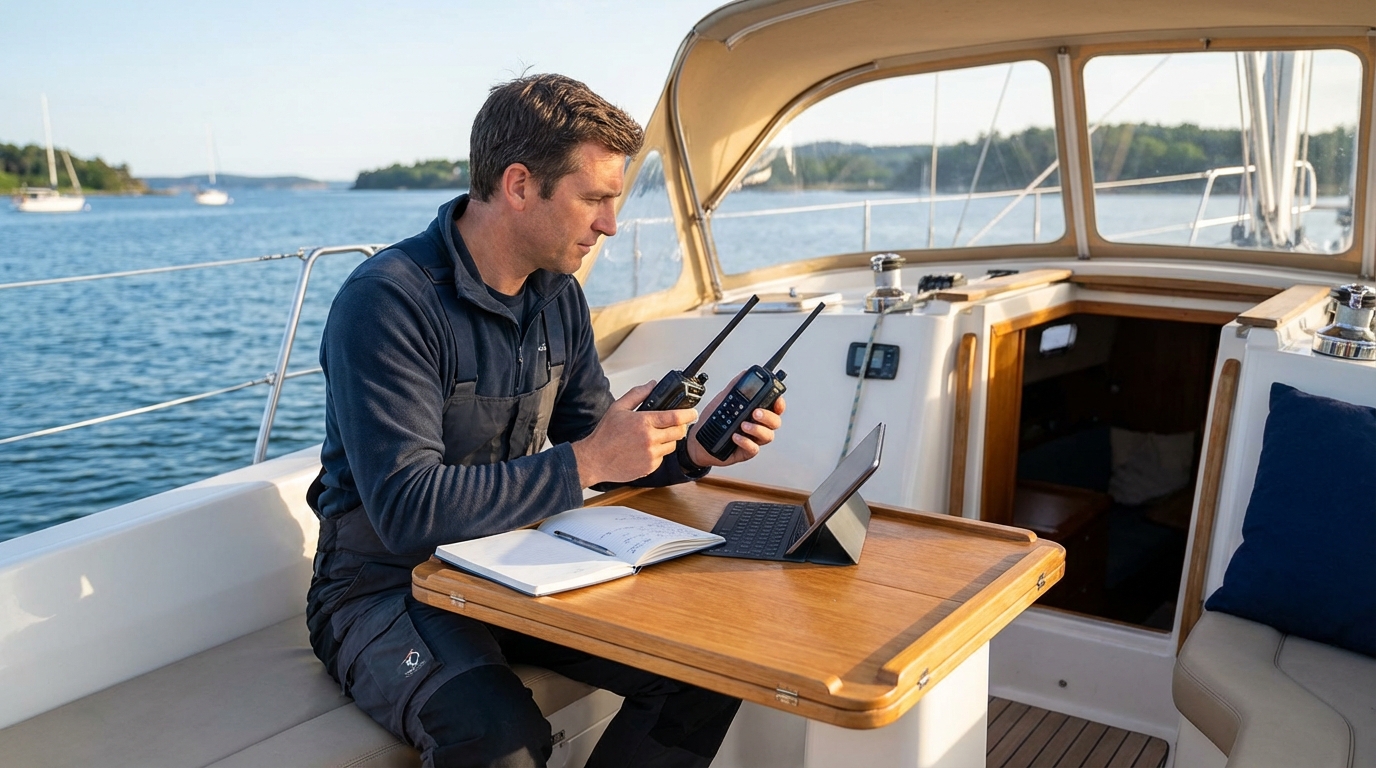
The DSC menu usually includes several types of calls:
- Individual Call: A direct “page” to one specific vessel using its MMSI.
- Group Call: A call to a predefined group of boats (useful for yacht clubs or fishing fleets).
- All Ships Call: A broadcast to every DSC radio within range, used for safety warnings or emergencies.
- Position Request: A digital query to another boat to see their current GPS coordinates.
- Position Report: A digital transmission of your own coordinates to another vessel.
To make an individual call, you typically navigate to the “Individual Call” menu, select the vessel from your directory (or enter the MMSI manually), choose a working channel (like 68 or 72), and hit send. The other boat’s radio will alert the crew, and when they acknowledge, your radio will automatically switch to the chosen channel. It is a much cleaner way to communicate in busy harbors.
Activate the Emergency Distress Button Properly
The emergency distress button on your handheld DSC radio transmits a digital signal containing your MMSI number and GPS coordinates to the Coast Guard and all nearby vessels. This button is almost always red and protected by a spring-loaded or flip-open cover to prevent accidental activation. When you press and hold this button—usually for three to five seconds—the radio enters “Distress Mode.”
Once activated, the radio sends a digital “Mayday” on Channel 70. This signal is repeated at frequent intervals until another station acknowledges it. Because the signal is digital, it can travel further than a voice transmission of the same power. When the Coast Guard receives it, their screens show exactly where you are and who you are. This eliminates the guesswork of traditional voice-based search and rescue.
When using the distress button, follow this protocol:
- Lift the cover: Expose the red button.
- Press and hold: Keep the button down until the countdown on the screen reaches zero.
- Wait for acknowledgment: The radio will show “Distress Acknowledged” once a rescue station receives the signal.
- Follow up with voice: Even though the digital signal is sent, you should still attempt a voice “Mayday” on Channel 16 to provide more details (e.g., “The boat is sinking,” or “Medical emergency”).
If you accidentally trigger the distress alert, do not just turn the radio off. You must announce a cancellation on Channel 16. Say, “All stations, All stations, All stations. This is [Vessel Name/MMSI]. We have accidentally triggered a DSC distress alert. Please cancel the alert. No assistance is required. Out.” Failing to do this can trigger an expensive and unnecessary search operation.
Evaluate Battery Life and Power Management
Handheld DSC radios consume significantly more power than standard handhelds because they must power an internal GPS receiver and a secondary digital watch receiver. While a standard VHF might last 20 hours on a charge, a DSC unit typically offers 8 to 12 hours of active use. In a survival situation, every milliamp counts.
Most modern units use Lithium-Ion (Li-Ion) batteries, which offer high energy density and hold their charge well during storage. However, the cold can degrade performance. If you are boating in northern latitudes in March, expect your battery life to drop by 20% or more. Always carry a spare battery pack or an alkaline battery tray that allows you to use standard AA or AAA batteries in an emergency.
Tips for Extending Battery Life:
- Lower the transmit power: Use the 1-watt setting for close-range communication and save the 6-watt setting for emergencies or long-range calls.
- Adjust GPS polling: Some radios allow you to change how often the GPS updates. Slower updates save power.
- Dim the backlight: The screen’s light is a major power drain; keep it as low as possible for daytime use.
- Turn off Bluetooth: If your radio has Bluetooth for smartphone integration, turn it off unless you are actively using it.
Many high-end models now feature “USB Charging.” This is a massive advantage because it allows you to charge the radio from a power bank, a solar panel, or a 12V cigarette lighter adapter without needing a bulky proprietary cradle. When selecting a handheld VHF marine radio with GPS, prioritize units with flexible charging options.
Understand Range and Signal Limitations
The range of a handheld DSC VHF radio is primarily determined by “line of sight” and the height of your antenna above the water. VHF signals do not follow the curve of the earth; they travel in straight lines. Because a handheld radio is usually held about 5 to 6 feet above the water, its horizon is quite close. Typically, you can expect a range of 3 to 5 miles to another handheld and 5 to 10 miles to a fixed-mount radio with a tall mast antenna.
The power of the radio—usually 5 or 6 watts for handhelds—helps “punch” the signal through atmospheric interference or rain, but it cannot overcome the physical barrier of the earth. If you are in a small dinghy or a kayak, your antenna is even lower, further reducing your range. This makes the DSC feature even more important, as the digital burst is more likely to be picked up by a distant shore station than a weak voice signal.
| Factor | Impact on Range | Solution |
|---|---|---|
| Antenna Height | Most critical factor | Stand up or hold the radio as high as possible. |
| Transmit Power | Helps with signal clarity | Use the high-power (6W) setting for distress calls. |
| Obstructions | Blocks signal (cliffs, buildings) | Move to open water or a high point. |
| Battery Level | Low voltage weakens signal | Keep the battery charged above 50%. |
| Antenna Type | Stock rubber ducks are inefficient | Use a longer “whip” antenna for better gain. |
To maximize your range, always hold the radio vertically. The signal is “vertically polarized,” meaning the antennas must be parallel for the best reception. If you are trying to reach a distant station, do not tilt the radio. Also, avoid gripping the antenna itself, as this detunes the circuit and kills your transmission power.
Navigate Licensing and Legal Requirements
In the United States, most recreational boaters do not need a personal license to operate a VHF radio in domestic waters, but the rules change for DSC and international travel. While you can use a voice-only VHF freely, the DSC functionality requires an MMSI, which is a form of registration. If you take your handheld radio to a foreign country, such as the Bahamas, Canada, or Mexico, you and your vessel legally require an FCC Ship Station License and a Restricted Radiotelephone Operator Permit.
The FCC treats a handheld DSC radio as a “mobile station.” If the radio is assigned to a specific boat, it falls under that boat’s license. If you carry the radio between different boats, you should ideally have a license that covers “portable” use. This ensures you are legally compliant and that your emergency data is accurate regardless of which vessel you are on.
Key Legal Points for 2026:
- Domestic Use: No license is needed for most recreational boats in US waters (voice/DSC).
- International Use: FCC Ship Station License is mandatory.
- MMSI Obligation: It is illegal to provide false information when registering an MMSI.
- Channel 70: It is strictly forbidden to use Channel 70 for voice communication; it is for digital data only.
- Radio Silence: You must yield the airwaves to any station transmitting a distress (Mayday) signal.
According to using a VHF radio effectively, the Coast Guard monitors Channel 16 and Channel 70 twenty-four hours a day. Misuse of the DSC distress button can result in heavy fines and even jail time if the “hoax” is intentional. Treat the red button with the same respect you would a flare gun or a life raft.
Select the Best Handheld DSC VHF Radio Features
When shopping for a handheld DSC radio in 2026, you should look for specific physical features that enhance survival and usability in harsh marine environments. A “floating” design is now standard for most high-quality units. If you drop your radio overboard during a night-time docking or a rough sea state, you want it to stay on the surface and, ideally, flash a light so you can find it.
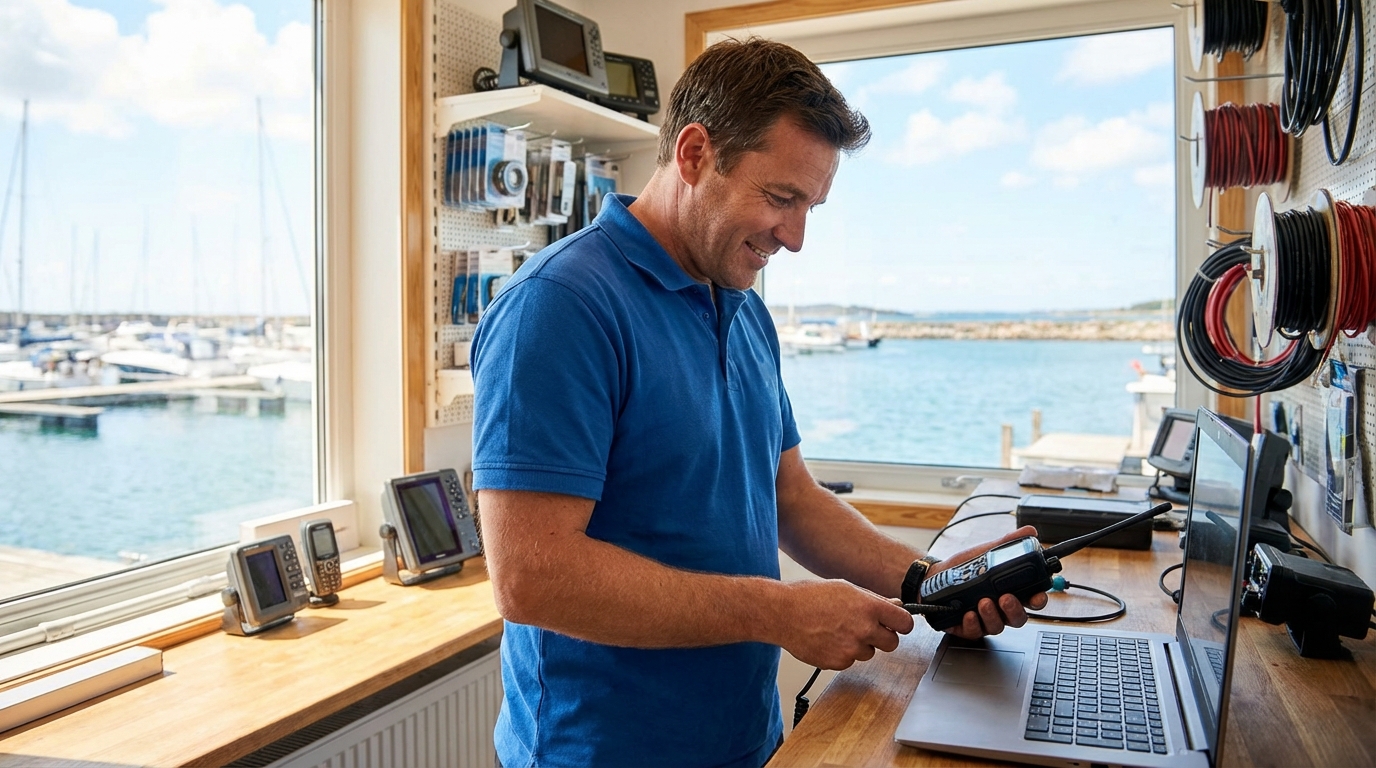
Waterproofing ratings are also vital. Look for a rating of at least IPX7, which means the radio can be submerged in 1 meter of water for 30 minutes. IPX8 is even better, offering protection for deeper or longer submersions. Some modern radios also include a “water clearing” feature that uses low-frequency sound to vibrate the speaker grill and eject water after the radio has been submerged, ensuring your voice is clear immediately after a dunking.
Essential Feature Checklist:
- Float and Flash: The radio floats and automatically activates a strobe light when it hits the water.
- Built-in GPS: A multi-constellation receiver (GPS, GLONASS, Galileo) for faster position fixes.
- Noise Cancelling: Digital processing to remove engine and wind noise from your transmissions.
- Waypoints and Navigation: The ability to save locations and use the radio as a basic backup navigator.
- Loud Speaker: At least 700mW of audio output to be heard over wind and waves.
- Bluetooth Integration: The ability to pair with a smartphone to make “cellular” calls through the radio’s rugged hardware or to update settings via an app.
Many boaters are now choosing radios with integrated AIS (Automatic Identification System) receivers. While these radios cannot transmit your AIS position to other boats, they can receive the positions of nearby ships and display them on the radio’s screen. This is a massive safety boost for small boaters navigating busy shipping lanes at night or in fog.
Maintain Your Device for Longevity
Maintaining a handheld DSC VHF radio requires regular attention to the battery contacts and the rubber seals that keep water out. Saltwater is extremely corrosive. After every trip, you should wipe the radio down with a damp cloth soaked in fresh water. Pay special attention to the charging contacts on the back of the radio. If salt builds up there, it will create high resistance, causing the battery to charge slowly or not at all.
The battery itself has a lifespan. Even if you don’t use the radio often, the Li-Ion cells will degrade over three to five years. In 2026, it is best practice to replace your primary battery pack every four years. Periodically check the “O-ring” or gasket around the battery compartment or the accessory port. If the seal looks cracked or flattened, it will no longer be waterproof.
Monthly Maintenance Checklist:
- Freshwater Rinse: Remove all salt crystals from buttons and seams.
- Contact Cleaning: Use a cotton swab with a tiny amount of electrical contact cleaner on the charging points.
- Battery Cycle: Discharge the battery to about 20% and then charge it fully to keep the chemistry active.
- DSC Test Call: Perform a “DSC Test Call” (not a distress call!) to a coast station or a friend to ensure the digital modem is working.
- Firmware Updates: Connect the radio to your computer or smartphone app to check for software updates that might improve GPS accuracy or battery efficiency.
Storage is also important. Never leave your radio in a hot cabin or in direct sunlight for weeks at a time. Heat is the number one killer of lithium batteries and LCD screens. Store the radio in a cool, dry place, and keep it in its charging cradle or a dedicated spot in your ditch bag so you know exactly where it is when things go wrong.
Integrate With Other Onboard Electronics
In the modern 2026 marine environment, your handheld DSC VHF radio can often communicate with your smartphone or chartplotter via Bluetooth or NMEA 2000 gateways. Some high-end handhelds allow you to transfer waypoints and routes from your mobile navigation app directly to the radio. This is incredibly useful if you need to use the radio’s internal GPS for emergency navigation to a waypoint you planned on your tablet.
Smartphone integration also allows for easier MMSI management. Instead of clicking through clunky menus on the radio’s small screen, you can often use a manufacturer’s app to type in names for your “buddy list” and then sync them to the radio. This makes individual DSC calling as easy as picking a contact from your phone’s address book.
Ways to Integrate Your Handheld:
- Smartphone Apps: Use apps to program channels, monitor battery status, and update firmware.
- AIS Sharing: Some radios can send received AIS data to a tablet via Bluetooth, effectively turning your iPad into a radar-like display.
- Emergency Sync: Pair your radio with your PLB (Personal Locator Beacon) or inReach device so that if one triggers, the other also prepares for emergency mode.
While these “smart” features are convenient, never forget that the radio’s primary job is communication. Don’t let a dead smartphone prevent you from knowing how to use the radio’s manual controls. Expertise comes from knowing how to operate the device when the fancy integrations fail. If you want to see a deep dive into a specific high-spec unit, read this Mhs335bt 6w Class D Handheld Marine Vhf Radio Review to see how Bluetooth and DSC work together in the field.
FAQ
Can I use a handheld DSC radio without an MMSI number?
You can use the radio for standard voice communication on all channels, but the DSC features will not work. The red “Distress” button will either fail to send or will send a signal without identifying data, which significantly slows down rescue efforts. Most radios will also emit a persistent beep or warning message until an MMSI is programmed.
Does a handheld DSC radio replace an EPIRB?
No, a handheld DSC VHF is a short-range device (3–10 miles), while an EPIRB (Emergency Position Indicating Radio Beacon) communicates with satellites and works anywhere in the world. A handheld DSC radio is excellent for local rescue and communicating with nearby boats, but an EPIRB is necessary for offshore or remote adventures where you are beyond the reach of VHF towers.
How do I perform a DSC test call?
You should never use the red distress button for a test. Instead, go to the “DSC Menu,” select “Test Call,” and enter the MMSI of a nearby station or a Coast Guard automated test MMSI (where available). The radio will send a digital “ping,” and the receiving station will send an automatic acknowledgment, confirming your digital modem and GPS are functioning correctly.
Is a handheld DSC radio waterproof if the battery is removed?
Usually, no. The waterproof seal is often formed by the gasket between the battery pack and the radio body. If the battery is not properly seated and locked, or if it is removed entirely, water can enter the internal circuitry and destroy the radio instantly. Always ensure the battery is securely latched before going near the water.
Can I use my handheld DSC radio on land?
Technically, it is illegal in many jurisdictions (including the US) to use a marine VHF radio on land without a specific shore station license. These frequencies are reserved for maritime safety and navigation. Using them on land can interfere with legitimate marine traffic and may result in fines from the FCC.
The Critical Role of Handheld DSC in Your Safety Kit
A handheld DSC VHF radio is no longer an optional luxury; it is the cornerstone of modern marine safety. In my years of hands-on work with marine electronics, I have seen how quickly a simple mechanical failure can turn into a life-threatening situation. Having the ability to transmit your exact location digitally, without needing to speak, removes the “human error” factor from the most stressful moments on the water.
When you choose a unit, don’t just look at the price. Prioritize a clear screen, a long-lasting battery, and an interface that you find intuitive. Once you have it, spend an afternoon practicing with the menus until you can navigate to the “Position Request” or “Individual Call” features without looking at the manual. In an emergency, your muscle memory will be as important as the radio itself. This device is your voice when you cannot speak and your location when you are lost—treat it as the vital tool it is.
📅 Last updated: