
Standard VHF marine radio power output is strictly regulated, with fixed-mount units operating at a maximum of 25 watts and handheld units typically capping at 6 watts. This power level is designed to balance long-distance communication with the need to prevent signal interference across crowded waterways. While a 25-watt signal can theoretically reach over 20 miles, the physical limitations of “line-of-sight” transmission often mean that antenna height and placement are more influential than raw wattage. Understanding how to manage these power settings—switching between high-power (25W/6W) and low-power (1W) modes—is a fundamental skill for safe navigation, battery management, and legal compliance.
Whether you are navigating through busy channels or enjoying a peaceful day on the lake, a fixed-mount VHF radio serves as your primary lifeline to the Coast Guard and neighboring vessels. At VHF Radio (also known as ‘Marine Guide’), we focus on providing the practical data you need to make informed decisions about your electronics. In this guide, we will break down the mechanics of power output, the impact of cable loss, and why simply “cranking the watts” isn’t always the solution to poor reception.
Marine VHF Radio Equipment
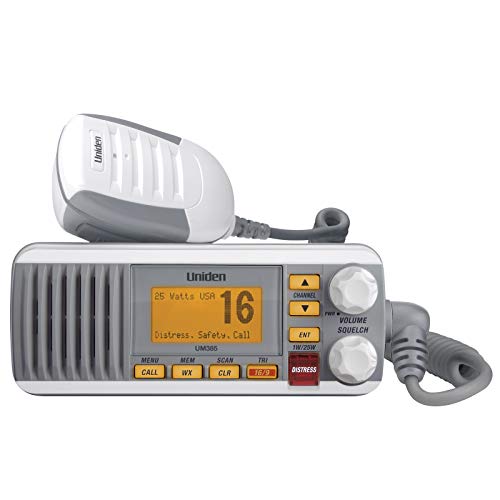
Uniden UM385 25 Watt Fixed Mount Marine Vhf Radio, Waterproof IPX4 with Triple Watch, Dsc, Emergency/Noaa Weather Alert, All Usa/International/Canadian Marine Channels, Memory Channel Scan, White
Uniden UM385 25 Watt Fixed Mount Marine Vhf Radio, Waterproof IPX4 with…
VIEW LATEST PRICE
Uniden UM385BK 25 Watt Fixed Mount Marine VHF Radio, Waterproof, Noaa Weather Alert, All USA/Intl/Canadian Marine Channels
Uniden UM385BK 25 Watt Fixed Mount Marine VHF Radio, Waterproof, Noaa Weather…
VIEW LATEST PRICE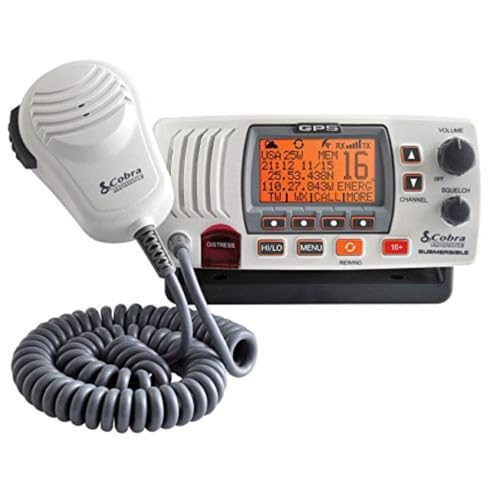
Cobra MR F77W GPS Fixed Mount VHF Marine Radio – 25 Watt VHF, Built-In GPS Receiver, Submersible, LCD Display, Noise Cancelling Mic, NOAA Weather, Signal Strength Meter, Scan Channels, White
Cobra MR F77W GPS Fixed Mount VHF Marine Radio – 25 Watt…
VIEW LATEST PRICEStandard Power Ratings for Fixed-Mount and Handheld Units
Fixed-mount VHF marine radios operate at two primary power levels: a high-power setting of 25 watts and a low-power setting of 1 watt. International and federal regulations (such as those from the FCC) mandate these specific tiers to ensure a level playing field for all maritime communicators. The 25-watt limit is the maximum allowed for civilian maritime use because any higher output would likely skip across the atmosphere and interfere with stations hundreds of miles away, a phenomenon known as “tropospheric ducting.”
Handheld VHF units, because of their smaller size and limited battery capacity, usually offer a maximum output of 5 or 6 watts. While some older models were limited to 5 watts, most modern handhelds sold in 2026 reach the 6-watt threshold to provide that extra bit of “punch” through atmospheric noise. Like their fixed-mount counterparts, handhelds must also include a 1-watt low-power setting for short-range communication.
| Radio Type | High Power Output | Low Power Output | Primary Power Source |
|---|---|---|---|
| Fixed-Mount | 25 Watts | 1 Watt | Vessel’s 12V Battery System |
| Handheld | 5W – 6W | 1 Watt | Internal Li-Ion Battery |
| Coastal Base Station | Up to 50W (Licensed) | N/A | Dedicated Power Grid |
When you look at marine VHF radio reviews, you’ll find that while almost all radios hit the 25-watt mark, the quality of the internal transmitter components determines how cleanly that power is delivered. A high-quality radio maintains its 25-watt output without distorting the audio or generating excessive heat, which can lead to “thermal throttling” during long transmissions.
Why Higher Wattage Does Not Always Mean Greater Range
VHF (Very High Frequency) signals travel primarily via line-of-sight, meaning that if the curvature of the earth or a physical obstacle stands between the transmitter and receiver, increasing the power output will not complete the connection. This is the most common misconception in marine electronics. You could theoretically have a 100-watt radio, but if your antenna is only three feet above the water, you will still fail to reach a boat ten miles away.
The signal leaves your antenna and travels in a relatively straight line. Because the Earth is curved, the signal eventually heads off into space rather than following the curve of the ocean. This point of departure is your “radio horizon.” If the receiving antenna is below your radio horizon, the signal simply passes over it.
Increasing wattage from 1 watt to 25 watts helps “fill in” the signal and overcome local interference, static, and weak receiver sensitivity. However, it does not significantly “bend” the signal around the horizon. High power is used to ensure a clear, readable signal (Signal-to-Noise Ratio) within your existing visual range, rather than trying to blast through the planet itself.
The Impact of Antenna Height on Effective Radiated Power (ERP)
Antenna height is the single most important factor in determining the range of your VHF marine radio power output. While the radio generates the raw wattage, the antenna’s elevation determines the geometric limit of your broadcast. This is why a sailboat with a 25-watt radio and an antenna 50 feet up the mast can talk to stations 20 miles away, while a powerboat with the same radio and an antenna only 10 feet off the water might struggle to reach 8 miles.
Effective Radiated Power (ERP) is a calculation that takes the radio’s output, subtracts the loss from the cables, and adds the “gain” provided by the antenna’s design. However, even a high-gain antenna cannot overcome a low physical height.
Consider these theoretical ranges based on antenna height:
- Antenna at 5 feet (Handheld at deck level): ~3 miles range.
- Antenna at 15 feet (Small powerboat): ~5 miles range.
- Antenna at 30 feet (Large sportfisher): ~7 miles range.
- Antenna at 60 feet (Sailboat mast): ~10 miles range.
To calculate your total range, you must add the range of your own radio horizon to the range of the person you are trying to reach. If you are 5 miles from the horizon and the Coast Guard tower is 15 miles from the horizon, you can communicate at 20 miles. This relationship is why the VHF marine radio buying guide emphasizes antenna selection and mounting location just as much as the radio features themselves.
Regulatory Requirements for Low-Power (1-Watt) Transmission
The Federal Communications Commission (FCC) and international maritime laws require certain channels to be restricted to 1 watt of power output to prevent interference in high-traffic areas. Using 25 watts in a crowded harbor is the equivalent of using a megaphone in a library; it prevents everyone else from being heard and creates a “blanket” of noise that can drown out distress calls.
Channels specifically designated for low-power use include:
- Channel 13: Used for bridge-to-bridge navigation and maneuvering. Large ships use this to coordinate passing. High power is actually discouraged here because these ships are usually within a mile of each other.
- Channel 67: Often used for bridge-to-bridge communication in specific regions.
- Port Operations Channels: Many local port channels are restricted to 1 watt to keep the signals localized to the docks and immediate surroundings.
Modern radios are programmed to automatically switch to 1-watt output when you tune to these specific channels. While some radios have a “hi/lo” override button that allows you to force 25 watts in an emergency, doing so during routine operations is a violation of maritime etiquette and, in some jurisdictions, the law. According to this guide to using VHF marine radio, maintaining disciplined power usage ensures that the frequency remains open for others who may have urgent needs.
Calculating Your Theoretical VHF Communication Distance
You can estimate your maximum communication range using the formula: Range (miles) = 1.22 × √Height (in feet). This formula provides the distance to the horizon for a single antenna. To find the total distance between two boats, you calculate the distance for both and add them together.
For example, if your antenna is mounted on your T-top at 9 feet:
- Square root of 9 = 3.
- 3 × 1.22 = 3.66 miles.
If you are trying to talk to a marina with an antenna at 25 feet:
- Square root of 25 = 5.
- 5 × 1.22 = 6.1 miles.
Total communication range = 3.66 + 6.1 = 9.76 miles.
This calculation assumes “perfect” conditions. In reality, factors like atmospheric moisture, signal “bounce” off the water, and interference from other electronics will reduce this. However, it illustrates why 25 watts of power is often more than enough—the limiting factor is almost always the height of the antenna, not the strength of the transmitter. If you find your range is lacking, check your fixed mount VHF radio installation for antenna height before considering a higher-gain antenna or a different radio.
How Cable Loss and Connectors Drain Your Radio’s Output
Power output at the radio does not equal power output at the antenna because every foot of coaxial cable and every connector along the line causes signal loss. This loss is measured in decibels (dB). For every 3 dB of loss, you lose half of your power. If your 25-watt radio is connected to a poorly chosen cable with 3 dB of total loss, only 12.5 watts actually reach the antenna.
The type of cable you use is critical. Standard RG-58 cable is thin and easy to route, but it has high loss over long distances. RG-8X (often called “Mini-8”) is slightly thicker and offers better performance. For long runs, such as up a sailboat mast, RG-213 or LMR-400 is preferred because of its heavy shielding and lower loss.
| Cable Type | Loss per 50ft at VHF Frequencies | Remaining Power (at 25W start) |
|---|---|---|
| RG-58 | ~3.1 dB | ~12.3 Watts |
| RG-8X | ~2.2 dB | ~15.1 Watts |
| RG-213 / RG-8U | ~1.2 dB | ~18.9 Watts |
| LMR-400 | ~0.7 dB | ~21.3 Watts |
Corroded connectors are the most common cause of “silent” power loss. A single salt-crusted PL-259 connector can introduce several decibels of loss, turning your 25-watt radio into a 5-watt weakling. When installing your system, always use high-quality silver-plated or nickel-plated connectors and seal them with adhesive-lined heat shrink tubing to prevent moisture intrusion.
Understanding Standing Wave Ratio (SWR) and Reflected Power
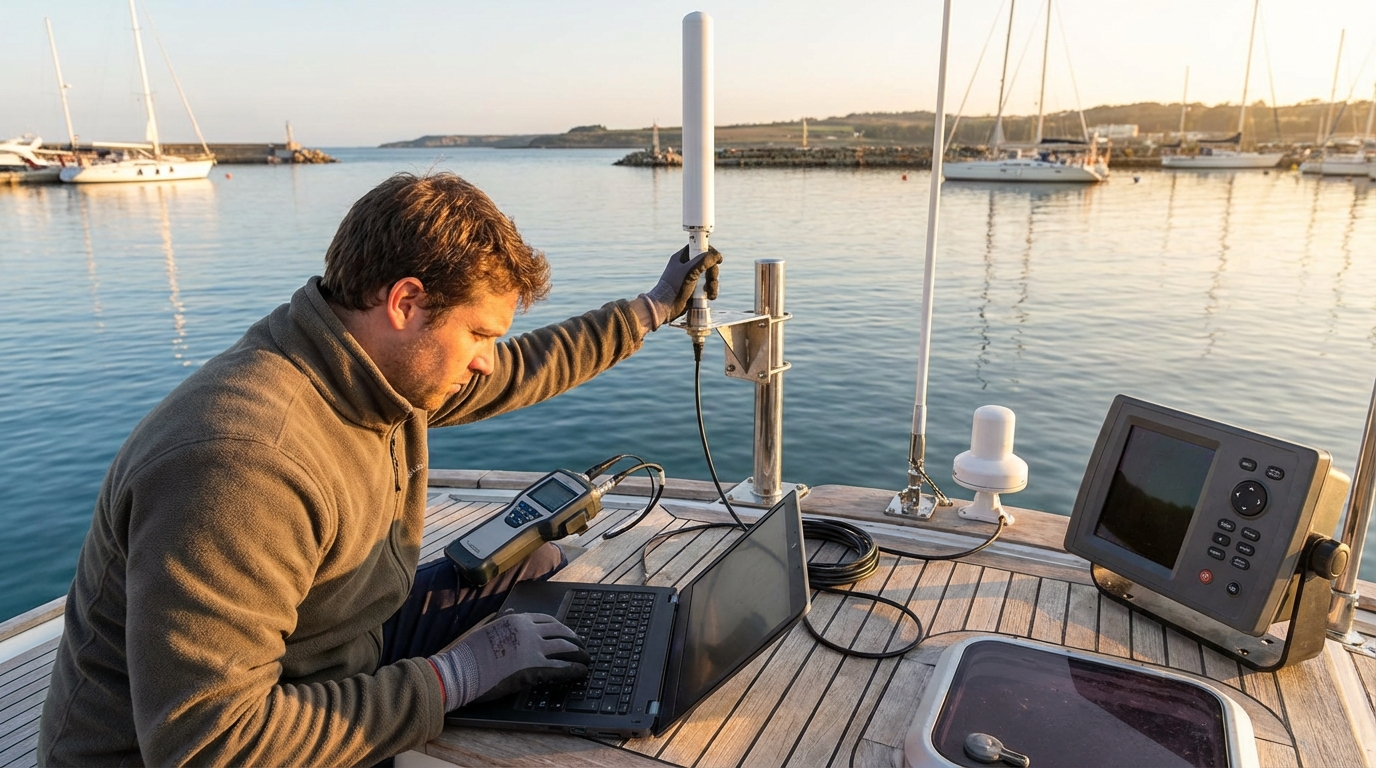
Standing Wave Ratio (SWR) measures how efficiently your radio’s power is being transmitted through the antenna versus how much is being “bounced back” into the radio. When the antenna is not perfectly matched to the frequency or the cable is damaged, some of the 25 watts of energy cannot escape the antenna. This energy reflects back down the wire toward your radio’s sensitive internal components.
A “perfect” SWR is 1:1, meaning 100% of the power is moving forward. In the real world, a ratio of 1.5:1 is considered excellent for a boat. If your SWR reaches 3:1 or higher, you are losing a significant portion of your output, and the heat generated by the reflected power can eventually burn out your radio’s power amplifier (the “finals”).
To check this, you can use an external SWR meter. If you transmit at 25 watts and the meter shows 5 watts of reflected power, your effective output is only 20 watts, and your radio is under stress. This issue is often discussed in boating forums as a primary reason for adjusting or troubleshooting VHF power output. If you suspect your radio isn’t “getting out,” an SWR test is the first diagnostic step.
When to Switch Your Radio to Low-Power Mode
You should switch to 1-watt low-power mode whenever you are communicating with a vessel or station within visual range, typically 1 to 2 miles. Using low power is not just about following rules; it’s about clear communication. At very close ranges, a 25-watt signal can actually “overload” the receiver on the other boat, causing the audio to sound distorted, crunchy, or unintelligible. This is known as receiver desensitization or “clipping.”
Situations for 1-Watt usage:
- Docking Maneuvers: Talking to a deckhand or a dockmaster.
- Raft-ups: Communicating with the boat tied right next to you.
- Intra-ship Comms: On larger vessels, talking between the bridge and the engine room.
- Battery Conservation: If your engine is off and you are running on house batteries, transmitting at 1 watt uses significantly less current (typically less than 1 Amp) compared to 25 watts (which can draw 5-7 Amps).
For handheld users, the low-power setting is essential for making the battery last through a full day on the water. A handheld radio used exclusively on 6-watt high power might only last for 4-6 hours of moderate use, whereas the 1-watt setting can extend that to 12-15 hours. If you are looking for longevity, consider the best handheld VHF marine radio with GPS, as these units are optimized for power management.
Battery Management and Voltage Requirements for Peak Output
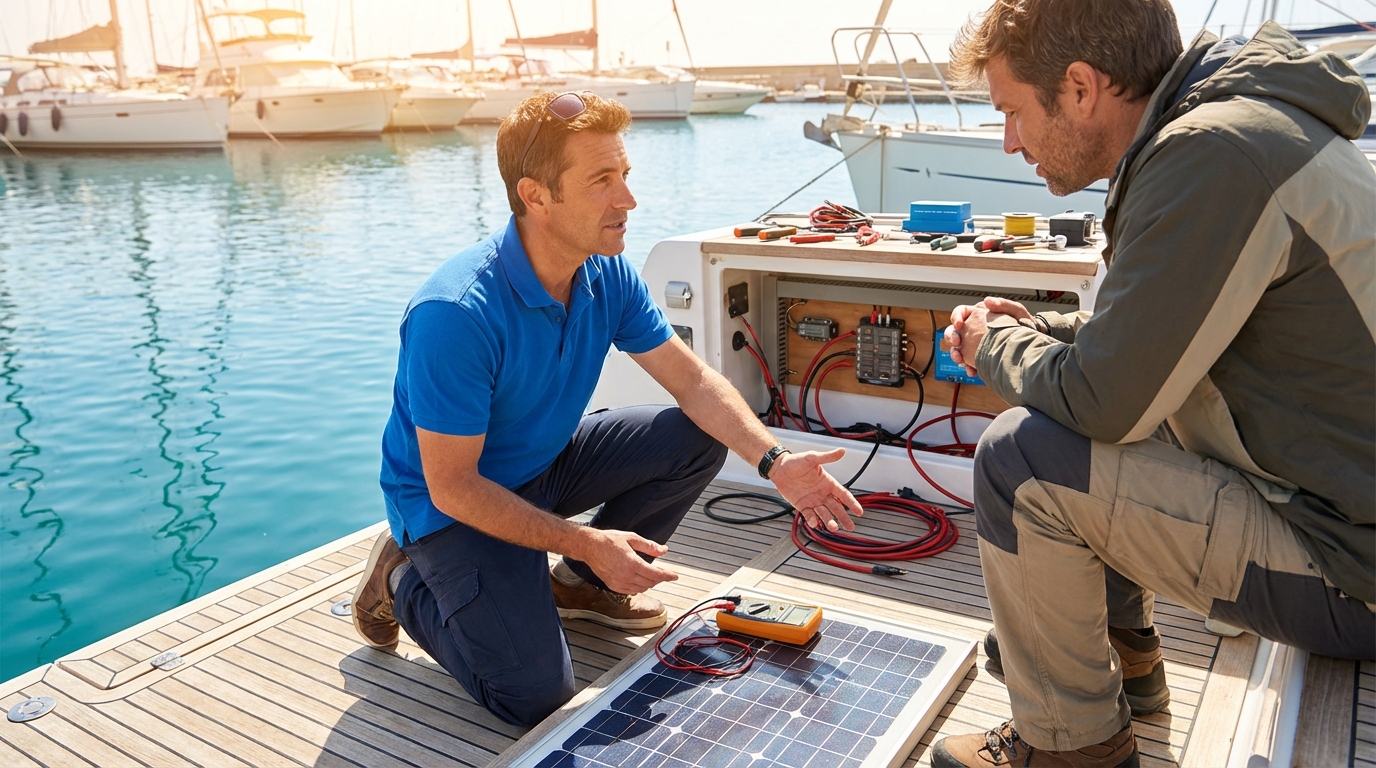
A VHF radio requires a steady supply of 13.8 volts to produce a full 25-watt output; if your battery voltage drops, your transmission power will drop proportionally. Most boaters think of their electrical system as “12 volts,” but a fully charged battery under charge from an alternator usually sits around 13.8V to 14.2V. If your battery is aging or your wiring is too thin, the voltage might “sag” when you key the mic.
The “Voltage Drop Test” is a professional way to see if your power output is being choked. Connect a voltmeter to the power input at the back of the radio. Note the voltage while the radio is on standby (e.g., 12.6V). Then, key the microphone on a non-emergency channel at 25 watts and watch the meter. If the voltage drops below 11.5V, your radio is not outputting 25 watts. Instead, the internal circuitry is likely struggling, and your signal will be weak and noisy.
To prevent this:
- Use at least 14 AWG wire for short runs and 12 AWG for longer runs.
- Ensure all battery terminals are clean and free of the “green crust” of corrosion.
- Avoid sharing the same thin power wire with other high-draw electronics like fishfinders or radar units.
Digital Selective Calling (DSC) and Its Relation to Power Output
Digital Selective Calling (DSC) sends a digital data “burst” at the full 25-watt capacity of your radio, designed to be more reliable than voice transmissions in emergency situations. Because DSC is a digital signal rather than an analog voice wave, it can be decoded by a receiver even when it is buried in static that would make a human voice unintelligible. In essence, the 25 watts “goes further” when used for DSC than for voice.
When you press the red distress button, your radio automatically switches to Channel 70 and broadcasts your MMSI number and GPS coordinates at maximum power. It will continue to repeat this burst at high power until an acknowledgment is received. This is the most critical use of your radio’s 25-watt capability.
According to the Marine VHF Radio Handbook from Good Hope Sailing Academy, the digital nature of DSC allows it to have about a 15-20% greater effective range than a standard voice call at the same wattage. This makes it the most effective way to summon help when you are at the absolute edge of your radio’s range.
Comparing High-Power Handhelds (6W) to Fixed Installations
A 6-watt handheld radio has approximately 25% of the raw power of a 25-watt fixed unit, but its real-world range is usually limited to 3-5 miles due to its low antenna height. Handhelds are excellent as secondary “backup” radios or for use in dinghies and kayaks, but they cannot replace the reach of a fixed-mount system with a masthead antenna.
The difference in power output is most noticeable when there is “noise” on the frequency. A 25-watt signal can “shout over” the background static of a distant thunderstorm or the electrical interference from a nearby engine. A 6-watt handheld signal may be present, but it might be too weak to be heard clearly over that same noise.
However, modern handhelds are very efficient. If you choose from the best marine VHF radio handheld options, you are getting a device tuned for maximum sensitivity. Even though its output is lower, its ability to “hear” distant stations is often surprisingly close to that of a fixed radio, provided the signals aren’t blocked by geography.
Troubleshooting Weak Transmission Signals and Power Failures
If you receive reports that your signal is “weak but readable” or “full of static,” the problem is rarely the radio’s internal power settings and is almost always an issue with the antenna system. Radios rarely “lose” wattage gradually; usually, the power amplifier works, or it doesn’t. If the radio turns on and you can hear others, but they can’t hear you, the “pathway” for your power is likely blocked.
Common Culprits for Power Loss:
- Moisture in the Coax: If the outer jacket of your cable is nicked, water can wick into the shielding. This creates a massive amount of resistance, absorbing your 25 watts and turning it into heat inside the cable.
- Loose Antenna Base: Many whip antennas screw into a base. If this connection is loose, the power cannot jump the gap efficiently.
- Low Battery Voltage: As discussed, if your boat’s battery is at 11.8V, you are likely only transmitting at 10-15 watts.
- Internal Settings: Ensure you haven’t accidentally locked the radio into “Low” (1W) power mode. Most radios display a small “L” or “LO” on the screen when this is active.
A basic explanation of how VHF marine radio functions reminds us that the radio is just one part of a system. To fix a “weak” signal, you must inspect the battery, the wire, the connectors, and the antenna in that order.
Selecting the Right Power Specifications for Your Boating Style
Your need for maximum power output depends on your distance from shore and the density of local boat traffic. If you primarily boat on small inland lakes, a 25-watt fixed radio is often overkill, and a 6-watt handheld is perfectly sufficient. However, for coastal or offshore boaters, the 25-watt fixed mount is non-negotiable for safety.
- Inland/Lake Boaters: A handheld is often enough. The distances are short, and help is usually nearby. High-power usage is rarely necessary.
- Coastal Boaters: A 25-watt fixed radio is the standard. You need the power to reach through coastal “clutter” and communicate with the Coast Guard from 10-15 miles out.
- Offshore/Blue Water: You need 25 watts plus a high-gain, high-mounted antenna. At this range, you are also likely supplementing your VHF with an AIS (Automatic Identification System), which uses its own VHF power output to broadcast your position to other ships.
When choosing your gear, don’t just look at the wattage. Look at the Current Draw specifications. A radio that draws 6 Amps at 25 Watts is more efficient than one that draws 8 Amps for the same output. Efficiency means less heat and less strain on your boat’s electrical system, which is vital when you’re miles from the dock.
Expert Perspective: Maximizing Your Communication Reach
At VHF Radio (Marine Guide), we have seen thousands of boaters focus on the “25 Watts” sticker on the box while ignoring the $20 cable that carries that power. The most important takeaway regarding VHF marine radio power output is that wattage is a secondary factor to antenna efficiency and height. You can have the most powerful transmitter in the world, but if your connections are corroded or your antenna is buried behind a radar arch, your signal will fail.
To ensure you are actually getting the power you paid for, perform an annual “Radio Check.” Don’t do this on Channel 16; use a designated local channel or an automated radio check service. If you get a “loud and clear” from a station five miles away, your system is likely healthy. If they report you are “faint,” it is time to check your voltage and your coax connectors. In the world of marine communication, 25 watts is your “loudness,” but your antenna is your “vision”—and on the water, you need both to stay safe.
📅 Last updated: