
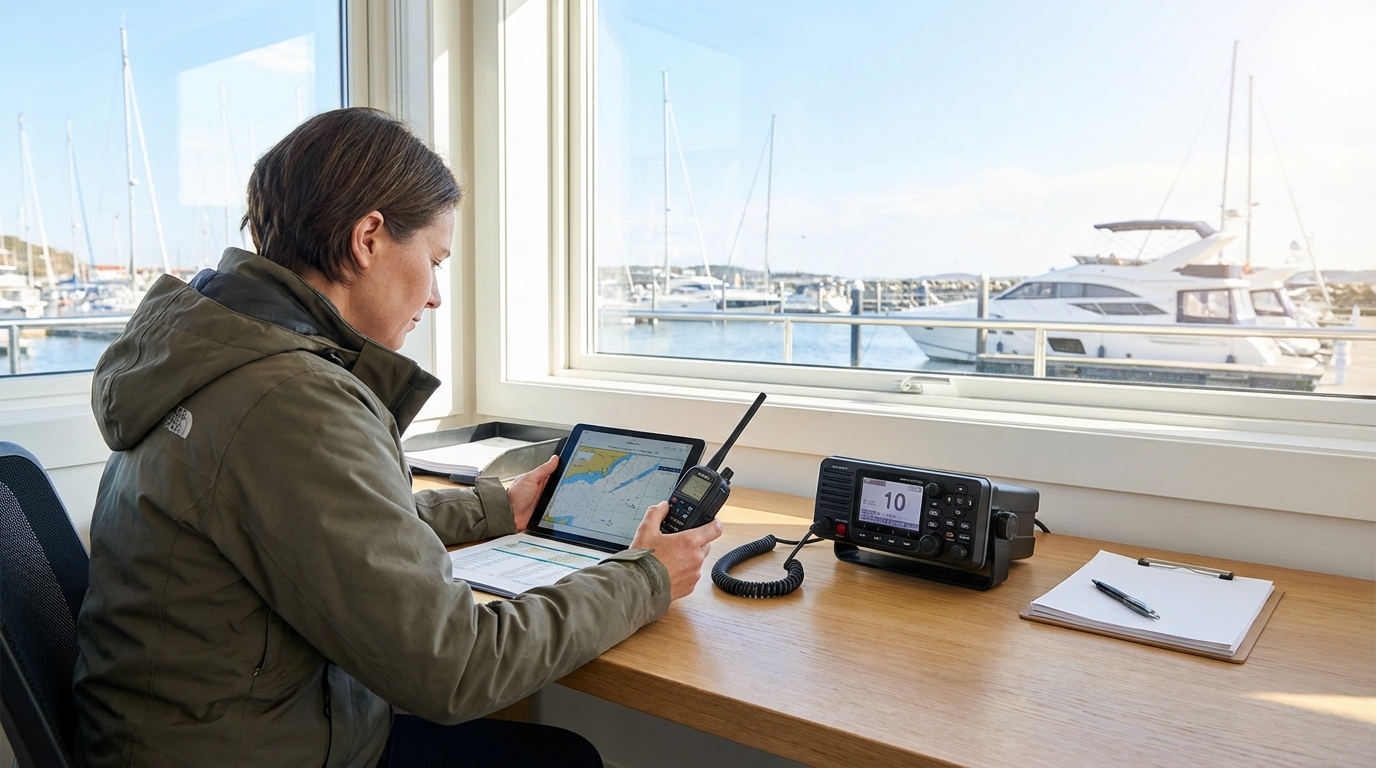
A vhf dsc marine radio buying guide helps you select a communication device that combines standard voice transmission with digital distress signaling to ensure your safety on the water. This guide breaks down the technical specifications, mounting options, and regulatory requirements you need to understand before making a purchase. You will learn how to evaluate range, power, and integration features to keep your vessel connected in all conditions.
Key Takeaways
- DSC is mandatory for safety because it allows for one-touch distress signaling that transmits your exact GPS coordinates to rescue authorities.
- Fixed-mount radios offer 25 watts of power, providing the maximum legal range for ship-to-shore and ship-to-ship communication.
- Handheld radios serve as excellent backups or primary tools for small boats, typically offering 6 watts of power and portable convenience.
- Built-in GPS simplifies installation by removing the need to wire your radio to an external chartplotter for location data.
- An MMSI number is required to activate the digital features of your radio and must be registered to your specific vessel.
- Antenna height is the most critical factor for determining your actual communication distance due to the line-of-sight nature of VHF signals.
Understanding Digital Selective Calling (DSC) Technology
Digital Selective Calling (DSC) is a core safety technology that allows marine radios to send automated distress signals including vessel identification and location. It functions like a digital paging system that operates on Channel 70, which is reserved exclusively for digital data. When you press the red distress button, the radio sends a burst of data that other DSC-equipped vessels and the Coast Guard receive instantly. This data includes your Maritime Mobile Service Identity (MMSI) and your current coordinates if the radio has GPS access.
VHF DSC Marine Radios and Accessories

Uniden UM385BK 25 Watt Fixed Mount Marine VHF Radio, Waterproof, Noaa Weather Alert, All USA/Intl/Canadian Marine Channels
Uniden UM385BK 25 Watt Fixed Mount Marine VHF Radio, Waterproof, Noaa Weather…
VIEW LATEST PRICE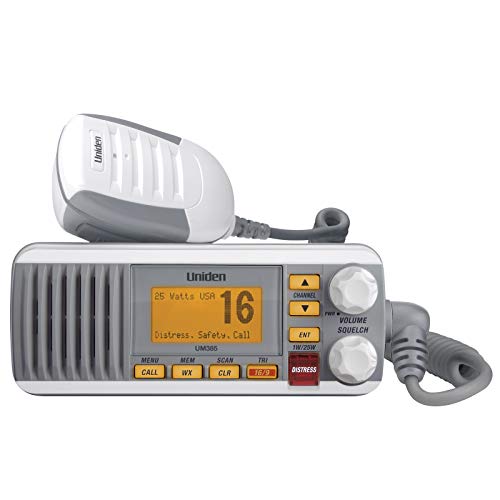
Uniden UM385 25 Watt Fixed Mount Marine Vhf Radio, Waterproof IPX4 with Triple Watch, Dsc, Emergency/Noaa Weather Alert, All Usa/International/Canadian Marine Channels, Memory Channel Scan, White
Uniden UM385 25 Watt Fixed Mount Marine Vhf Radio, Waterproof IPX4 with…
VIEW LATEST PRICE
Retevis RM20 Marine VHF Radios Fixed Mount, Marine Band Radio with Built in GPS, DSC, IP67 Waterproof, High Power, NOAA Weather, International Channels, Ship to Shore Radio for Boats(Black)
Retevis RM20 Marine VHF Radios Fixed Mount, Marine Band Radio with Built…
VIEW LATEST PRICEAccording to a basic guide to VHF DSC radios, these units also allow for private “polling” or direct calls to other specific vessels without broadcasting to everyone on the channel. You can enter the MMSI of a friend’s boat and “ring” their radio directly. This makes communication much more efficient in crowded waterways where voice channels are often congested.
| Feature | Function | Benefit |
|---|---|---|
| Distress Button | Sends automated SOS data | Faster rescue response |
| Position Request | Asks another boat for coordinates | Easy group navigation |
| Group Calling | Pages multiple specific boats | Coordinated fleet movement |
| Channel 70 Watch | Monitors digital signals constantly | Never miss an emergency alert |
Choosing Between Fixed-Mount and Handheld Units
Fixed-mount radios provide superior range and power for primary vessel communication, while handheld units offer essential backup and portable mobility. If you own a powerboat or sailboat with a cabin or console, a fixed-mount unit is usually the best primary choice. These units connect directly to your boat’s 12-volt battery system, ensuring they do not run out of power during long trips. They also use large, permanently mounted antennas that sit high above the water.
Handheld radios are indispensable for kayakers, personal watercraft users, or as a secondary “ditch bag” radio. They are limited by battery life and lower transmission power, but their portability is a life-saving feature if you must abandon ship. Many modern handhelds are buoyant and feature water-activated strobe lights to help rescuers find you in the dark. You can find detailed comparisons in our best marine vhf radio handheld review section.
- Fixed-Mount Pros: Higher power (25W), larger display, better range, permanent power source.
- Fixed-Mount Cons: Requires professional installation, not portable, dependent on boat battery.
- Handheld Pros: Portable, works if boat power fails, waterproof/buoyant, easy to use.
- Handheld Cons: Lower power (6W), limited battery life, shorter range due to small antenna.
Maximizing Range with Power and Antenna Height
Maximum VHF communication range is a result of antenna height above the waterline rather than the electronic power of the transmitter. VHF signals travel in a “line-of-sight” pattern, meaning the curve of the Earth eventually blocks the signal. Even with a 25-watt radio, your signal will not travel past the horizon. Raising your antenna increases that horizon significantly.
For example, a handheld radio held five feet above the water might have a range of 3 to 5 miles. A fixed-mount radio with an antenna on top of a 20-foot mast can often reach 15 to 20 miles. This is why sailboat owners frequently have much better range than powerboaters; their antennas are mounted 30 to 60 feet in the air. You must prioritize high-quality coaxial cable and secure connectors to ensure the 25 watts of power actually reach the antenna without loss.
- 3dB Gain Antennas: Best for small boats or rolling seas because they have a wider signal pattern.
- 6dB Gain Antennas: The standard for most powerboats, offering a balanced, compressed signal for better distance.
- 9dB Gain Antennas: Used on large ships or very stable platforms to reach maximum distances.
Implementing MMSI Numbers for Emergency Safety
Your Maritime Mobile Service Identity (MMSI) is a vital nine-digit registration number that acts like a digital phone number for your vessel’s radio. Without an MMSI programmed into the unit, the DSC distress features will not function. This number links your radio to a database containing your vessel description, owner contact information, and emergency shore contacts.
As explained in the National Safe Boating Council guide, you can obtain an MMSI through organizations like BoatUS or the United States Power Squadrons if you operate domestically. If you plan to travel to international ports, you must obtain the number directly from the FCC. You must take care when entering this number into your radio, as many manufacturers only allow one or two attempts before the unit requires a factory reset to change it.
Why the MMSI is Critical:
- It identifies your boat to the Coast Guard instantly.
- It provides your phone number and emergency contacts to rescuers.
- It allows you to make “private” digital calls to other boats.
- It is required for the “Auto-Acknowledge” feature of DSC.
Integrating GPS and NMEA Networking
Modern VHF radios use GPS data to provide position coordinates during distress calls and facilitate easy navigation to specific waypoints. Older DSC radios required a complex wire connection to a separate GPS chartplotter. Today, you should look for a radio with a built-in GPS receiver to ensure the radio always knows where it is, regardless of your other electronics.
If you choose a radio without built-in GPS, you must use NMEA 0183 or NMEA 2000 networking to share data. NMEA 2000 is the modern standard, using a “plug and play” backbone system that is much easier to install. By connecting your radio to your boat’s network, your chartplotter can display the locations of other boats that send you a DSC position request. For a look at the top-rated integrated units, see our best fixed mount vhf marine radio guide.
Networking Comparison:
- NMEA 0183: Older standard, involves stripping small wires and matching pairs. It is prone to interference and wiring errors.
- NMEA 2000: Modern standard, uses five-pin circular connectors. It allows the radio to communicate seamlessly with fishfinders, plotters, and engines.
- Built-in GPS: The simplest option. It works even if your main navigation screen fails or the network loses power.
Evaluating Waterproofing and Durability Ratings
Marine radios carry specific IPX ratings that define their ability to withstand water immersion or high-pressure sprays in harsh ocean environments. When reading a vhf dsc marine radio buying guide, you must look for at least an IPX7 rating for any radio exposed to the elements. An IPX7 rating means the radio can survive being submerged in one meter of water for 30 minutes.
If you have an open cockpit or a center console boat, the radio will face constant salt spray and heavy rain. Higher-end models often feature IPX8 ratings, which provide even greater protection against continuous immersion. You should also check for “JIS” ratings, which are the Japanese Industrial Standards equivalent. A “JIS8” rating is generally equivalent to IPX8.
| Rating | Protection Level | Ideal Use Case |
|---|---|---|
| IPX4 | Splashing water | Inside a fully enclosed cabin |
| IPX6 | High-pressure water jets | Exposed bridge or console |
| IPX7 | Temporary immersion (1m) | Standard for all handhelds |
| IPX8 | Continuous immersion | High-end handhelds and ditch-bag units |
Enhancing Awareness with AIS Receiver Features
Integrated Automatic Identification System (AIS) receivers allow your radio to display the position and heading of nearby commercial ships on your screen. AIS is a tracking system used by ships and vessel traffic services for identifying and locating vessels by electronically exchanging data. Having an AIS receiver built into your VHF radio is a massive safety advantage when navigating in fog or busy shipping lanes.
Some high-end VHF radios even include AIS transponders, which not only see other ships but also broadcast your position to them. This ensures that a massive container ship knows you are there, even if they cannot see you on radar. While more expensive, an integrated AIS/VHF unit saves space on your dashboard and reduces the number of antennas you need to install. Our marine vhf radio reviews often highlight which models offer the best AIS display clarity.
Benefits of AIS Integration:
- Collision Avoidance: See the speed and course of nearby ships.
- CPA Alarms: The radio alerts you if a ship’s path comes within a dangerous distance (Closest Point of Approach).
- Target Identification: Know the name of the ship so you can call them on the radio directly.
- Simplified Wiring: One screen shows both communication and traffic data.
Simplifying Use with Intuitive Interface Designs
A clear user interface with dedicated buttons for common functions ensures you can operate the radio effectively during high-stress emergency situations. You do not want to navigate deep menus just to change the squelch or adjust the backlight. Look for a radio with large, tactile buttons that you can operate while wearing gloves or in rough seas.
The display should be high-contrast and easy to read in direct sunlight. Many modern radios use dot-matrix displays that can show icons, GPS coordinates, and AIS targets clearly. A “soft-key” system, where the buttons change function based on what is shown on the screen, can also make the radio much easier to use.
- Dedicated Channel 16/9 Button: Must be easy to find in the dark.
- Rotary Knobs: Preferred over push-buttons for volume and squelch adjustments.
- Backlit Keypad: Essential for night navigation and emergency use.
- Speaker Clarity: Look for noise-canceling technology to filter out wind and engine noise.
Managing Weather Alerts and Scanning Functions
Weather alert features keep you informed of local environmental changes by automatically scanning NOAA frequencies for urgent storm warnings. Most marine radios sold in North America come pre-programmed with all NOAA weather channels. A critical feature to look for is “Weather Alert,” which allows the radio to monitor for a special tone that indicates a severe weather broadcast is starting.
Scanning functions are also vital for staying informed. “Dual Watch” or “Triple Watch” allows you to monitor Channel 16 (the emergency channel) while also listening to your working channel or a weather channel. This ensures you never miss a distress call from a nearby boat while you are talking to your fishing partners. You can learn more about these procedures in our guide on how to use dsc vhf radio.
- Priority Scan: Constantly checks Channel 16 between other transmissions.
- Memory Scan: Only cycles through the channels you have saved as favorites.
- Weather Alert: Interrupts your current activity to play an emergency weather broadcast.
Installing Your Marine Radio System Correctly
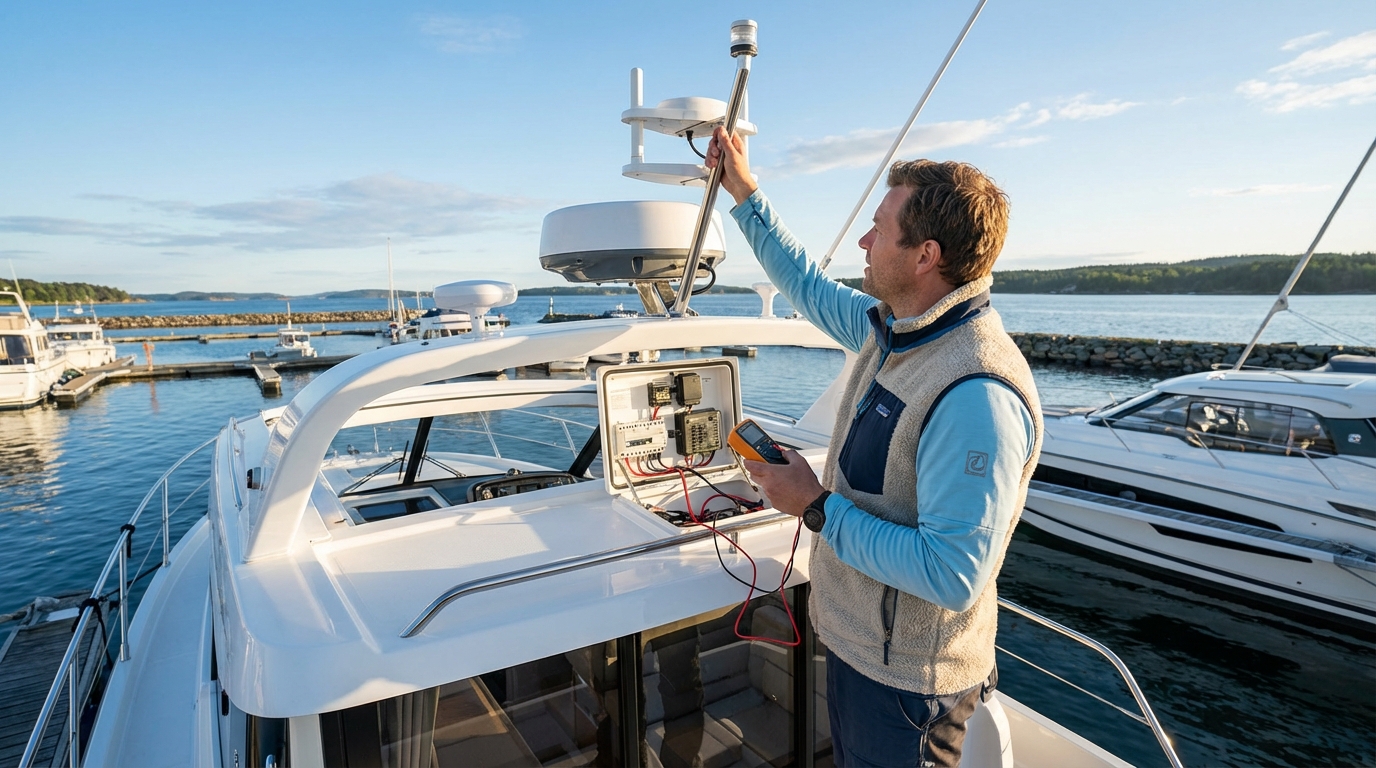
Proper installation of a fixed-mount radio requires secure mounting, direct connection to a 12-volt power source, and high-quality coaxial cabling. You should avoid sharing a power circuit with high-draw items like windlasses or pumps, as this can cause voltage drops that reduce your transmission range. Always use tinned copper marine-grade wire to prevent corrosion in the salty air.
The antenna installation is the most common point of failure. You must ensure the antenna has a clear “view” of the horizon and is mounted as high as possible. If you use a folding mount, check the tension regularly to ensure the antenna doesn’t vibrate loose. Using a high-quality PL-259 connector with a waterproof boot is essential for long-term performance.
Installation Checklist:
- Mounting: Use stainless steel hardware and a backing plate if necessary.
- Power: Fuse the positive lead and connect directly to the battery or a dedicated bus bar.
- Grounding: Ensure the radio is properly grounded to prevent radio frequency (RF) interference.
- Coax Routing: Avoid sharp bends in the cable and keep it away from other electrical wires.
- SWR Test: Use a Standing Wave Ratio (SWR) meter to verify your antenna is reflecting minimal power back into the radio.
Navigating FCC Licensing and Legal Requirements
Recreational boaters in US domestic waters generally do not need an individual station license, but international travel requires specific FCC permits. If you plan to sail to the Bahamas, Mexico, or Canada, you must have a Restricted Radiotelephone Operator Permit and a Ship Station License. These licenses ensure you are part of the international search and rescue database.
Even if you don’t need a license, you are still legally required to follow radio etiquette. This includes staying off Channel 16 except for hailing and emergencies and using the minimum power necessary for clear communication. Misusing the “Red Button” or making false distress calls carries heavy fines and potential jail time.
Legal Fast Facts:
- Channel 16: For distress, safety, and calling only. No “chatter.”
- Power Settings: Use 1W (Low Power) for close-range harbor communication to avoid interference.
- Identification: You must identify your vessel by name or call sign at the end of every transmission.
- Secrecy of Correspondence: It is illegal to divulge the contents of any message you overhear on the radio.
Selecting the Right Equipment for Your Vessel
Choosing the right VHF DSC radio is a commitment to the safety of everyone on your boat. By prioritizing features like built-in GPS, high IPX waterproof ratings, and AIS integration, you create a communication hub that can handle the worst conditions. Remember that the radio is only as good as its installation; invest in the highest quality antenna and cabling you can afford. At VHF Radio (also known as Marine Guide), we recommend that every boater carries both a fixed-mount unit for range and a handheld unit for backup. This redundancy ensures that no matter what happens to your boat’s electrical system, you still have a way to call for help and stay informed about the world around you.
📅 Last updated: