
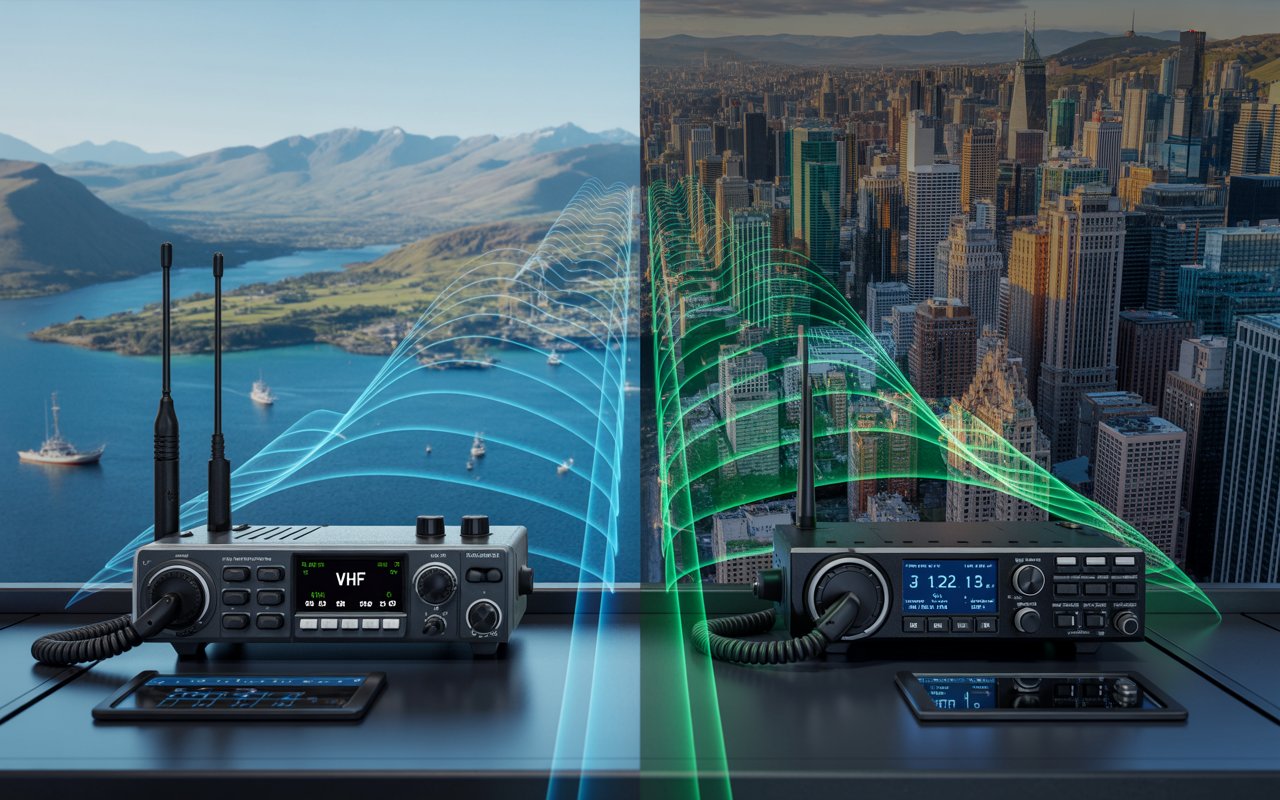
Understanding the differences, advantages, and real-world uses of VHF and UHF radio systems.
Introduction
In today’s rapidly evolving communication landscape, UHF (Ultra High Frequency) and VHF (Very High Frequency) radios continue to play a vital role across countless industries and recreational activities.
From:
- Marine communication
- Emergency response
- Construction sites
- Aviation
- Security teams
- Hiking and camping
- Ham radio operations
…VHF and UHF radios remain some of the most dependable communication tools available in 2026.
This guide explains:
- What VHF and UHF radios are
- How they work
- Their frequency ranges
- The key differences between them
- Which one may be better for your specific needs
What Is UHF and VHF Radio?
To understand the difference between VHF and UHF radios, it helps to first understand radio frequencies.
Radio communication works by transmitting signals over electromagnetic waves. Different frequency ranges behave differently depending on terrain, buildings, weather, and distance.
What Is VHF Radio?
VHF stands for Very High Frequency.
VHF Frequency Range
30\ \text{MHz}\ \text{to}\ 300\ \text{MHz}
VHF radios are best known for:
- Long-distance outdoor communication
- Open terrain performance
- Marine and aviation communication
- Rural area coverage
Common Uses for VHF Radios
- Marine radios
- Aviation communication
- Rural emergency services
- Outdoor recreation
- Hiking and hunting
- Farm and ranch communication
Advantages of VHF
✅ Longer outdoor range
✅ Better performance in open areas
✅ Less signal attenuation over distance
✅ Often lower equipment cost
Limitations of VHF
❌ Struggles inside buildings
❌ More affected by hills and dense urban environments
❌ Reduced penetration through walls and concrete
What Is UHF Radio?
UHF stands for Ultra High Frequency.
UHF Frequency Range
300\ \text{MHz}\ \text{to}\ 3000\ \text{MHz}
UHF radios are optimized for:
- Indoor communication
- Urban environments
- Dense construction areas
- Better wall penetration
Common Uses for UHF Radios
- Security teams
- Construction sites
- Warehouses
- Event coordination
- Hospitality industries
- Law enforcement
Advantages of UHF
✅ Better building penetration
✅ Stronger performance indoors
✅ Clear audio in crowded environments
✅ Compact antenna sizes
Limitations of UHF
❌ Shorter outdoor range
❌ More susceptible to signal blockage over long distances
❌ Frequencies can become crowded in cities
Key Differences Between VHF and UHF Radios
| Feature | VHF | UHF |
|---|---|---|
| Frequency Range | 30–300 MHz | 300 MHz–3 GHz |
| Best Environment | Open outdoor areas | Indoor and urban areas |
| Wall Penetration | Weak | Strong |
| Long Distance Range | Better outdoors | Shorter outdoors |
| Antenna Size | Larger | Smaller |
| Marine Use | Excellent | Limited |
| Building Performance | Moderate/Poor | Excellent |
Does VHF or UHF Have Better Range?
This is one of the most common questions in radio communication.
In Open Outdoor Areas:
VHF usually has better range.
This is because lower frequencies travel farther across:
- Water
- Open fields
- Rural terrain
- Mountainous regions
In Buildings and Cities:
UHF generally performs better.
Its shorter wavelengths allow it to:
- Penetrate walls
- Move through concrete structures
- Navigate urban obstacles more effectively
Can UHF Penetrate Walls?
Yes — UHF is significantly better at penetrating walls and obstacles than VHF.
This makes UHF ideal for:
- Warehouses
- Office buildings
- Schools
- Hotels
- Hospitals
- Shopping centers
However, no radio frequency penetrates perfectly. Materials like:
- Steel
- Reinforced concrete
- Thick masonry
…can still weaken UHF signals.
How Does VHF Radio Work?
VHF radios transmit electromagnetic waves over lower frequencies.
Because the wavelengths are longer, they:
- Travel farther outdoors
- Follow terrain more effectively
- Experience less attenuation over distance
VHF communication generally works best in line-of-sight conditions.
Examples:
- Boat-to-boat communication
- Aircraft communication
- Rural emergency communication
How Does UHF Radio Work?
UHF radios use higher frequencies and shorter wavelengths.
These shorter wavelengths:
- Bounce through obstacles more effectively
- Work better in confined spaces
- Support denser communication environments
This makes UHF highly effective for urban and indoor operations.
Which Is Better: VHF or UHF?
There is no universal “best” option.
The right choice depends entirely on your environment and intended use.
Choose VHF If You Need:
✅ Long outdoor range
✅ Marine communication
✅ Rural coverage
✅ Open terrain performance
✅ Better communication over water
Best For:
- Boating
- Hiking
- Farming
- Search and rescue
- Aviation
Choose UHF If You Need:
✅ Indoor communication
✅ Building penetration
✅ Urban performance
✅ Clear communication in crowded environments
Best For:
- Construction sites
- Warehouses
- Security teams
- Hotels
- Schools
- Event management
Can VHF and UHF Radios Communicate Together?
Normally, no.
VHF and UHF radios operate on different frequency bands, so they cannot directly communicate with each other unless:
- A cross-band repeater is used
- A dual-band radio system is configured
- Specialized interoperability equipment is installed
How to Tell If Your Radio Is VHF or UHF
Here are several ways to identify your radio type.
Check the Frequency Label
VHF Frequencies:
Typically between:
30\ \text{MHz}\ \text{to}\ 300\ \text{MHz}
UHF Frequencies:
Typically between:
300\ \text{MHz}\ \text{to}\ 3000\ \text{MHz}
Common Consumer Examples
VHF Examples:
- 136–174 MHz
- Marine channels around 156 MHz
UHF Examples:
- 400–520 MHz
- Many business radios
Check the Antenna
Generally:
- VHF radios use longer antennas
- UHF radios use shorter antennas
Common Myths About VHF and UHF Radios
Myth: UHF Always Has Better Range
False.
UHF performs better indoors, but VHF often travels farther outdoors.
Myth: More Watts Always Means Better Communication
Not necessarily.
Terrain, antenna quality, building density, and interference matter just as much as transmitter power.
Myth: UHF Is Always Clearer
Clarity depends on:
- Signal strength
- Interference
- Equipment quality
- Environment
Not simply the frequency band.
Real-World Examples
VHF Marine Communication
VHF remains the gold standard for marine radio communication because signals travel efficiently over water and provide long-range reliability.
UHF in Urban Security
Security teams working inside hotels, stadiums, hospitals, and shopping centers often rely on UHF radios for reliable indoor communication.
Tips for Choosing the Right Radio
Before purchasing a radio, ask yourself:
1. Will I Mostly Be Indoors or Outdoors?
- Indoors → UHF
- Outdoors → VHF
2. Are There Many Buildings or Obstacles?
- Yes → UHF
- No → VHF
3. Do I Need Long-Distance Communication?
- Usually VHF
4. Will I Be Using Repeaters?
Repeaters can dramatically improve both VHF and UHF coverage.
Final Thoughts
Even in 2026, VHF and UHF radios remain essential communication tools across industries, emergency services, recreation, and transportation.
Remember:
- VHF is generally better for long-range outdoor communication
- UHF is generally better for indoor and urban communication
Choosing the right radio depends on understanding your environment, range requirements, and communication goals.
With the proper setup, either system can provide years of reliable communication performance.
📅 Last updated: