
Key Takeaways
- The height of your antenna is the primary factor in determining the maximum distance your signal can travel over the water.
- Upgrading to a high-gain aftermarket antenna can significantly increase your transmission clarity without needing more battery power.
- Most modern handheld marine radios use either SMA or TNC connector types which are not cross-compatible without an adapter.
- Regular inspection for “hand-shading” and connector corrosion prevents common causes of signal loss during emergencies.
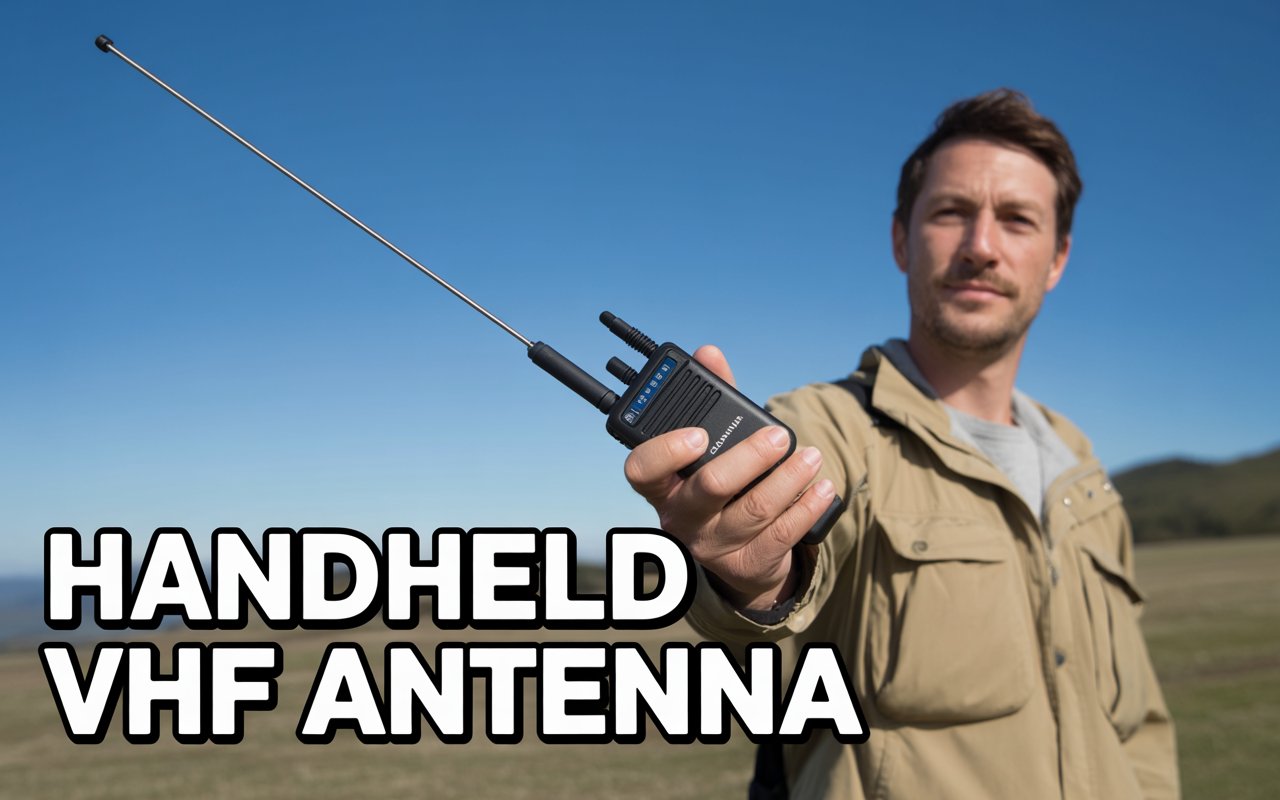
- Holding your radio vertically is essential because marine VHF signals use vertical polarization for standard communication.
- A flexible “rubber ducky” antenna is designed for durability, while a longer whip antenna provides better signal resonance.
Understanding How a Handheld VHF Antenna Works
A handheld VHF antenna functions as a transducer that converts electrical energy from your radio’s transmitter into radio frequency (RF) waves. To work effectively, the antenna must be resonant, meaning its physical length is mathematically matched to the wavelength of the frequencies you are using. In the marine VHF band, a full wavelength is approximately 2 meters, so most handheld antennas are designed as quarter-wave or loaded half-wave radiators.
Internal components of these antennas usually consist of a conductive wire or spring, often made of copper or stainless steel, encased in a protective polymer. Because a 19-inch (quarter-wave) antenna is often too long for a handheld device, manufacturers use a “loading coil” at the base. This coil adds electrical length through inductance, allowing the physical antenna to be much shorter while remaining resonant.
Handheld VHF Antennas

Shakespeare 4′ Centennial VHF Antenna, White
Shakespeare 4′ Centennial VHF Antenna, White
VIEW LATEST PRICE
Bingfu Handheld Marine VHF Radio Antenna VHF 136-174MHz Rubber Duck SMA Male Antenna for Standard Horizon HX210 HX870 HX890 HX300 HX380 HX40 HX280 HX290 HX370 Boat Handheld Floating VHF Two Way Radio
Bingfu Handheld Marine VHF Radio Antenna VHF 136-174MHz Rubber Duck SMA Male…
VIEW LATEST PRICE
HYS VHF Marine Antenna Waterproof 3DBI 43.3inch Fiberglass Antennas W/22.9ft(7m) RG58 Low Loss Premium Coaxial Cable with PL259/ Built-in to Nylon Ratchet Mount
HYS VHF Marine Antenna Waterproof 3DBI 43.3inch Fiberglass Antennas W/22.9ft(7m) RG58 Low…
VIEW LATEST PRICE- Resonance: The state where the antenna’s electrical length matches the frequency of the radio signal.
- Loading Coil: A spiral of wire that allows a short antenna to behave like a much longer one.
- Radiator: The physical part of the antenna that emits the radio waves.
- Counterpoise: The “other half” of the antenna system, which in handhelds is often the radio chassis and your hand.
Comparing Common Handheld Antenna Connector Types
Most marine handheld radios use standardized connectors to ensure a secure, waterproof attachment between the antenna and the radio body. The two most frequent types you will encounter in 2026 are the SMA (Sub-Miniature version A) and the TNC (Threaded Neill–Concelman) connectors. Knowing which one your radio uses is vital before you purchase a replacement or an upgrade.
| Connector Type | Visual Characteristics | Common Usage | Pros/Cons |
|---|---|---|---|
| SMA-Male | Small threaded nut with a center pin | Icom, Standard Horizon, some Uniden | Very compact; can be fragile if over-tightened. |
| SMA-Female | Small threaded barrel with a center hole | Various budget marine handhelds | Found on many multi-band radios; requires specific adapters. |
| TNC | Larger threaded connector, similar to BNC | Heavy-duty commercial handhelds | Extremely rugged; handles physical stress well. |
| BNC | Twist-and-lock mechanism (no threads) | Older legacy models and adapters | Fast to remove; not as waterproof as threaded options. |
If you are unsure of your connector type, consult your installation guide for marine VHF antennas to identify the specific threading required. Using the wrong connector or an ill-fitting adapter can lead to water ingress, which destroys the radio’s internal circuitry through salt-air oxidation.
Evaluating Gain and Signal Directionality
Antenna gain is a measurement of how much an antenna focuses radio energy in a specific direction compared to a standard reference point. For handheld VHF units, gain is usually expressed in decibels (dBi or dBd). A higher gain antenna does not actually “create” more power; instead, it compresses the signal into a flatter, wider pattern that stays closer to the horizon where other boats and shore stations are located.
Standard “rubber ducky” antennas that come with your radio usually have a gain of 0 dB to 2 dB. They radiate energy in a pattern shaped like a large donut. High-gain antennas, often measuring 12 to 15 inches in length, have gains of 3 dB to 6 dB. This focuses the energy into a much thinner disc shape. While this increases range, it also means that if you tilt the radio significantly, your signal may overshoot or undershoot the receiving station.
The Impact of Antenna Height on Communication Range
Radio signals in the VHF band travel primarily via line-of-sight, making the height of your antenna the single most important factor for distance. Because the Earth is curved, the horizon acts as a physical barrier to radio waves. When you stand on the deck of a boat, your handheld antenna is roughly 5 to 6 feet above the water line, providing a theoretical range of about 3 to 5 miles to another person at the same height.
If you are communicating with a Coast Guard station that has an antenna 200 feet up a tower, your range increases significantly because they can “see” over your horizon. This relationship is why understanding why the height of a vhf radio antenna is important is fundamental for every coastal mariner. If you are in a kayak or a low-profile dinghy, your range is even more restricted, often to less than 2 miles between vessels.
Range Estimation Table (Approximate Miles)

- Handheld to Handheld (both at sea level): 3-5 miles.
- Handheld to Fixed Mount (6db antenna on hardtop): 8-12 miles.
- Handheld to Coast Guard Tower: 20-30 miles.
- Handheld in Life Raft (low elevation): 1.5-3 miles.
Upgrading to Aftermarket Handheld Antennas
Replacing the factory-issued antenna with a high-performance aftermarket model is the most cost-effective way to improve your radio’s performance. Many stock antennas are built for durability and compactness rather than peak electrical efficiency. An aftermarket whip antenna, often made of highly flexible nitinol or specialized polymers, can provide better resonance and a lower Standing Wave Ratio (SWR).
When you look for the best marine vhf radio handheld options, many users immediately pair them with a 15-inch flexible whip. This upgrade is particularly useful for those who frequently operate on the edges of coverage areas. These longer antennas are more efficient at capturing weak signals, which can be the difference between hearing a distorted message and a crystal-clear weather update.
- Materials: Look for antennas with gold-plated connectors to prevent corrosion.
- Flexibility: Ensure the antenna can bend 90 degrees without snapping, as it will inevitably hit rigging or gear.
- Tuning: Choose an antenna pre-tuned for the 156-163 MHz band specifically, rather than a wide-band “amateur radio” antenna.
Proper Handheld VHF Antenna Orientation and Usage
Vertical polarization is the standard for all marine VHF communications, meaning the antenna must be held straight up and down for maximum signal transfer. When the transmitting antenna and the receiving antenna are both vertical, the signal is transferred with minimal loss. If you hold your radio at a 45-degree angle while talking, you can lose up to 3 dB of signal strength, which effectively cuts your transmitter power in half.
Another common mistake is “hand-shading,” where your hand or body blocks the line-of-sight between the antenna and the receiving station. Since your body is composed mostly of water, it absorbs RF energy very effectively. Always hold the radio away from your face and ensure your fingers are not wrapped around the base of the antenna itself. This allows the antenna to utilize the radio’s chassis as a proper ground plane.
Durable Materials for Harsh Marine Environments
The materials used in a handheld VHF antenna must withstand constant exposure to UV radiation, salt spray, and physical impact. High-quality antennas use an outer jacket made of Ethylene Propylene Diene Monomer (EPDM) or high-grade silicone. These materials remain flexible in cold weather and do not crack under the intense sun of tropical climates.
The internal radiator is equally important. Stainless steel is common for its strength, but some high-end models use copper-plated spring steel for better conductivity. When evaluating any marine antenna, check the seal at the connector base. A high-quality antenna will have an O-ring or a tight-fitting rubber skirt that prevents saltwater from reaching the threaded connection. According to marine VHF antenna basics from Fisheries Supply, the integrity of the weather seal is often the first point of failure in handheld units used on open decks.
Measuring Performance with Standing Wave Ratio (SWR)
Standing Wave Ratio (SWR) is a mathematical representation of how much power your radio sends to the antenna versus how much is reflected back due to an impedance mismatch. A perfect SWR is 1.0:1, though this is rarely achieved in the real world. For a handheld VHF antenna, an SWR of 1.5:1 or 2.0:1 is considered excellent. If your SWR rises above 3.0:1, your radio may reduce its power output to protect its internal components from heat damage.
While you cannot easily tune a standard “rubber ducky” antenna, you can test it using a specialized SWR meter and an adapter. If you notice your radio getting unusually hot during short transmissions, or if your battery dies much faster than usual, a high SWR caused by a damaged antenna is a likely culprit. Physical damage, like a crimp in the wire or water inside the housing, will immediately spike the SWR and kill your range.
Emergency Backup Antenna Strategies
Every boat should carry a backup or emergency antenna for their handheld radio in case the primary one is lost or broken. Some emergency kits include a “roll-up” J-pole antenna made of twin-lead wire. These can be hoisted up a mast or tied to a fishing pole to provide significantly more height than a standard handheld antenna.
Another option is a BNC-to-SMA adapter that allows you to connect your handheld radio directly to your boat’s main fixed-mount antenna. If your fixed-mount radio fails, you can move the cable to your handheld. This setup essentially turns your 5-watt handheld into a powerful station with a 20-foot or 60-foot “antenna height advantage,” dramatically extending your emergency reach.
Emergency Kit Essentials:
- SMA to BNC Adapter: To connect to shipboard antennas.
- Spare Factory Antenna: In case the original snaps.
- Telescopic Whip: For maximum range when stationary.
- Self-Amalgamating Tape: To seal connectors in a temporary setup.
Technical Differences Between 1/4 Wave and 1/2 Wave Antennas
The electrical design of your antenna—whether it is a quarter-wave or a half-wave—dictates how it interacts with the radio. A quarter-wave antenna is the most common for handhelds because it is short and simple. However, a quarter-wave antenna requires a “ground plane” (a conductive surface) to work properly. On a handheld, your body and the radio’s metal chassis act as this ground plane.
A half-wave antenna is “ground-independent,” meaning it does not need a counterpoise to radiate efficiently. These are typically longer (about 36 to 40 inches for VHF) and are often found in “sleeve” designs. While too large for a belt-mounted radio, they are excellent for stowing in a cabin and attaching when you need the absolute maximum range possible from a 5-watt or 6-watt handheld.
Troubleshooting Common Antenna Issues
If you find that you can hear other boats clearly but they cannot hear you, the problem is almost certainly located in the antenna system. Start by inspecting the base of the antenna where it threads onto the radio. Look for green or white powdery residue, which indicates salt corrosion. Clean the threads with a small amount of isopropyl alcohol and a soft brush.
Check the flexible body of the antenna for “memory” or permanent bends. If the internal wire has snapped due to repeated bending, the antenna may still look fine on the outside but will fail to transmit effectively. You can often feel a “soft spot” in the antenna where the internal conductor has failed. If the antenna feels limp or shows any cracks in the outer jacket, replace it immediately to prevent water from wicking into the radio’s motherboard.
Selecting the Right Antenna for Your Boating Style
The best antenna for your needs depends entirely on how you use your vessel. A coastal sailor in a large yacht has different requirements than a solo kayaker or a professional fisherman. You must balance the need for range with the practicalities of movement and durability.
- For Kayakers: Priority is waterproofing and a short, snag-free design. A 6-inch flexible antenna is often best to avoid catching on paddles or gear.
- For Offshore Anglers: Range is king. A high-gain 15-inch whip provides the best chance of reaching a distant buddy boat or the Coast Guard.
- For Dinghy/Tender Use: A mid-sized 9-inch antenna offers a good compromise between portability and clear communication back to the mother ship.
- For Emergency Bags: A telescopic antenna that can be collapsed for storage but extended to 19 inches for use is an ideal inclusion.
When searching for the best handheld vhf radio for boat use, always consider if the included antenna matches your specific environment. If you buy a radio for offshore use, budget for an immediate antenna upgrade to ensure you are getting the most out of the device’s 6-watt output.
Professional Maintenance and Care Routine
To ensure your handheld VHF antenna lasts as long as the radio itself, you should perform a basic maintenance check every three months. This is especially important for radios that are kept in “ditch bags” or emergency lockers where they might be forgotten. Salt air can penetrate even closed compartments, leading to slow-acting corrosion on the antenna’s metal contacts.
- Disconnect and Inspect: Remove the antenna and look for moisture or corrosion in the center pin of the SMA/TNC connector.
- Clean the Gasket: Wipe the rubber gasket at the base of the antenna with a damp cloth to remove salt crystals that could compromise the seal.
- Apply Dielectric Grease: A tiny amount of non-conductive dielectric grease on the threads can help prevent seizing and keep moisture out.
- Check for UV Damage: If the antenna jacket feels brittle or “chalky,” the plastic is breaking down from sun exposure and should be replaced.
FAQ
Can I use a regular walkie-talkie antenna on my marine VHF?
No, you cannot use a standard UHF or dual-band walkie-talkie antenna on a marine VHF radio because the frequencies are different. Marine VHF operates specifically between 156 and 163 MHz, while many land-based walkie-talkies operate in the 400-480 MHz range. Using the wrong antenna will result in a high SWR, which can destroy your radio’s transmitter within seconds of pressing the push-to-talk button.
Why is my range so much shorter than the advertised 5 miles?
Advertised range is often based on ideal conditions with a clear line-of-sight between two high-elevation points. In practice, factors like waves, atmospheric conditions, and “hand-shading” (your body blocking the signal) can reduce range. If you are sitting low in a boat and communicating with another low-profile vessel, your effective range may be as little as 2 miles.
Should I choose a flexible or a rigid antenna?
For most marine applications, a flexible antenna is superior because it can withstand the physical abuse of a moving boat. Rigid antennas are prone to snapping at the connector base if they are bumped or if the radio is dropped. However, some specialized long-range antennas are semi-rigid to maintain their vertical orientation; these should be handled with extra care.
Is a longer antenna always better?
Generally, a longer antenna is more efficient because it has more physical surface area to interact with radio waves and usually requires less “loading” to reach resonance. However, a 40-inch antenna is impractical for a handheld used while moving. The “sweet spot” for most handheld upgrades is between 12 and 15 inches, providing a significant boost in gain without becoming a liability.
Do I need a license to use a handheld VHF antenna?
In the United States, recreational boaters do not need a license to use a marine VHF radio (and its antenna) for domestic travel. However, if you plan to travel to international ports (including Canada or the Bahamas) or if you are a commercial operator, you must obtain a Restricted Radiotelephone Operator Permit and a Ship Station License from the FCC.
Maximizing Your Marine Communication Potential
Your handheld VHF antenna is far more than just a piece of flexible plastic; it is a precisely engineered tool designed to save your life. By choosing an antenna with the correct connector, maintaining the integrity of its seals, and understanding the physics of height and polarization, you ensure that your voice carries across the water when it matters most. Whether you are sticking with the factory-supplied equipment or upgrading to a high-gain whip, the principles of line-of-sight and resonance remain the same. Always test your equipment before leaving the dock, and never underestimate the value of a high-quality antenna in your safety arsenal. For those looking for the ultimate in reliability, reviewing the 5 best vhf antennas in 2023 for clear and reliable reception provides a solid foundation for your 2026 gear selection. As your trusted guide to marine radios, VHF communication, and essential boating accessories, we recommend that you treat your antenna with the same care as your engine or your hull.
📅 Last updated: