

Mastering the use of a compass while boating is a fundamental skill that could save your life when modern electronics fail. Whether you’re navigating coastal waters or venturing offshore, understanding your boat’s compass provides confidence and safety during your maritime adventures. This comprehensive guide covers everything from reading compass bearings to compensating for deviation, helping you become proficient in marine navigation using this timeless tool.
What is a marine compass and why is it essential for boat navigation?

A marine compass is a specialized navigational instrument designed specifically for use on boats and ships. Unlike standard compasses used for land navigation, a marine compass or ship’s compass is built to remain stable and accurate despite a vessel’s constant motion and vibration. This specialized compass is mounted permanently on a boat and serves as the primary reference for directional guidance.
Marine Compass and Navigation Tools
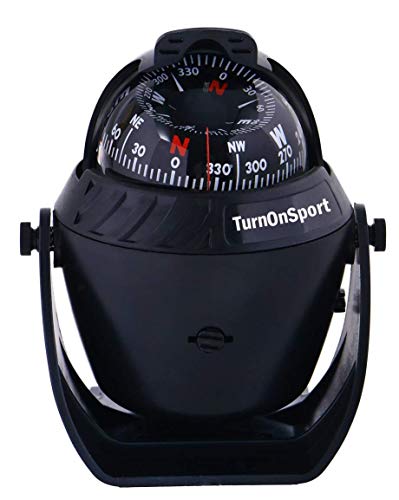
Boat Compass Dash Mount Flush – Boating Compass Dashboard Suction – Navigation Marine Compass Boats Surface Mount – Illuminated Dashboard Compass Ship – Electronic Sea Compass Suction Cup (Black)
Boat Compass Dash Mount Flush – Boating Compass Dashboard Suction – Navigation…
VIEW LATEST PRICE
Ritchie Navigation Flush Mount Compass, Black (F-50)
Ritchie Navigation Flush Mount Compass, Black (F-50)
VIEW LATEST PRICE
Marine Compass, Car Marine Navigation Compass with Adjustable Mounting Bracket, Car Marine Accessories, Marine RV Truck Accessories
Marine Compass, Car Marine Navigation Compass with Adjustable Mounting Bracket, Car Marine…
VIEW LATEST PRICEThe importance of a marine compass cannot be overstated—it remains the most reliable navigational tool available to boaters, functioning without batteries, satellite signals, or other external power sources that modern electronic navigation systems require.
The marine compass has been the cornerstone of navigation for centuries, allowing mariners to venture beyond the sight of land with confidence. Even in today’s technology-driven world, a magnetic compass remains an essential backup when GPS and other electronic systems fail.
Coast Guard regulations often require vessels to carry a properly functioning compass, recognizing its critical role in safe boating. When fog descends, electrical systems fail, or you find yourself disoriented in open water, your boat’s compass becomes your most trusted ally in finding your way home.
According to the U.S. Coast Guard, a marine compass is mandated on vessels to prevent navigation errors and ensure safety when other systems fail, highlighting its indispensable role in maritime activities.
Understanding the difference between a marine compass and other compass types

Marine compasses differ significantly from their land-based counterparts in both construction and functionality. A steering compass mounted at the helm differs from a hand bearing compass used for taking bearings to landmarks or lighthouses. The steering compass is firmly secured to compensate for the boat’s movement and is positioned for easy reference while at the helm.
It typically features a larger compass rose and more stable compass needle than a handheld compass. Marine compasses are also filled with liquid (usually a mixture of alcohol and water or specialized damping fluid) to stabilize the compass needle during rough conditions, ensuring smooth operation even in choppy seas.
Hand bearing compasses, another essential type used in marine navigation, are designed to be portable and allow the navigator to take precise bearings to landmarks, buoys, or other vessels. Many experienced boaters carry both types—a mounted steering compass for general navigation and a hand bearing compass for position fixing and navigational calculations.
The differences between these specialized marine instruments and basic land compasses make them far more reliable for nautical applications, where precision can mean the difference between safe passage and potential disaster.
How a magnetic compass functions on the water

A magnetic compass works by aligning itself with the earth’s magnetic field. The magnetized needle or card within the compass housing orients itself relative to magnetic north, providing a consistent reference point for navigation.
When mounted on a boat, the compass is carefully positioned on the centerline, typically near the helm, allowing the helmsperson to steer accurately by maintaining a compass course. The compass rose—the circular graduated dial marked with directions—allows the navigator to read bearings and determine which direction the boat is heading.
The compass’s operation is based on simple but profound principles of magnetism. The earth generates a magnetic field that flows between the magnetic north and south poles. This field isn’t perfectly aligned with the geographic poles (true north and true south), creating what navigators call magnetic declination—the angular difference between true north and magnetic north.
This relationship between true north and magnetic north is crucial for accurate navigation, particularly when working with nautical charts which are typically oriented to true north. Understanding how your magnetic compass interacts with the earth’s magnetic field is fundamental to using it effectively while boating.
Why electronic navigation should be backed up with compass skills
While modern electronic navigation systems like GPS, chartplotters, and radar have revolutionized marine navigation, relying exclusively on these technologies creates dangerous vulnerabilities. Electronic devices can fail due to power loss, water damage, or technical malfunctions.
GPS signals can be interrupted or degraded by atmospheric conditions, and even the most sophisticated electronic systems require interpretation and can lead to complacency. A skilled navigator understands that compass navigation provides an essential backup system that functions independently of external factors.
Learning to use a compass and developing map and compass skills creates a safety net for when technology fails. Numerous accounts exist of boaters becoming completely disoriented when their electronics stopped functioning, especially in conditions of limited visibility.
Practicing compass navigation techniques ensures you’ll never be completely lost, even when all electronic aids fail. The ability to take a bearing, plot a position, and steer a compass course are skills that separate seasoned mariners from those dangerously dependent on technology. Electronic navigation tools should complement—never replace—the fundamental compass skills that have guided mariners safely for centuries.
How do I properly read a compass bearing while boating?
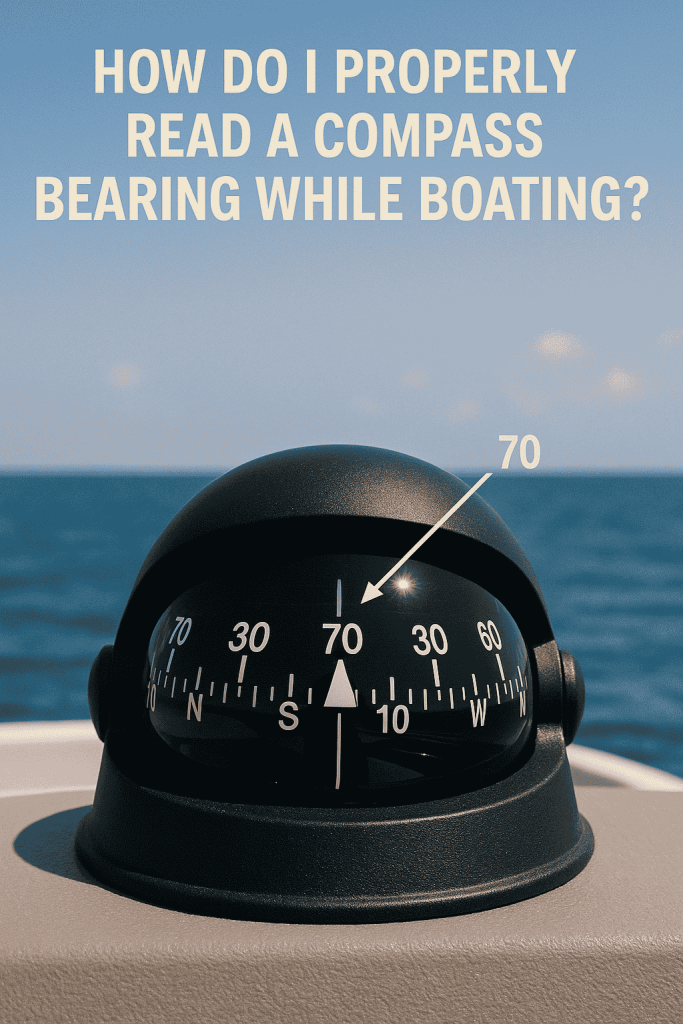
Reading a compass bearing accurately is a fundamental skill in marine navigation. To begin, you need to understand that a compass bearing is simply a direction expressed in degrees, measured clockwise from north. When using the compass while boating, you’ll need to hold it steady and align the compass needle with the compass rose’s north marking.
Most best marine compasses are graduated in degrees (0-359°), with the four cardinal points (N, E, S, W) marked at 0°, 90°, 180°, and 270° respectively. To take a bearing to a landmark or lighthouse, you’ll need to align your sight line with the object and read the degree marking where it intersects with the compass rose.
Precision matters when reading compass bearings. Even a small error of a few degrees can lead to significant positional errors over distance. Many experienced navigators recommend taking multiple bearings and averaging them to minimize errors. When reading your steering compass while underway, it’s important to maintain a consistent eye position relative to the compass to avoid parallax errors in your compass reading.
Practice is essential—spend time familiarizing yourself with your specific compass model in calm conditions before relying on it in challenging situations.
Interpreting the compass rose and compass needle
The compass rose is the graduated dial or card inside your compass that displays directional information. On most marine compasses, it’s divided into 360 degrees, with major cardinal and intercardinal points clearly marked.
The compass needle (or card in some marine compasses) aligns itself with the earth’s magnetic field, with the north-seeking end pointing toward magnetic north. When interpreting the compass rose, remember that it represents the plane of the horizon around your boat, with you at the center.
Modern marine compasses often feature a “lubber line”—a fixed reference mark on the compass housing that represents your boat’s heading. To determine your current direction of travel, you simply read the degree marking on the compass rose that aligns with the lubber line. When taking a bearing to a distant object, specialized compasses may have sighting mechanisms or alignment marks.
Understanding the relationship between the moving compass card and the fixed lubber line is essential for accurate navigation. Regular practice in reading your compass will build the confidence and speed necessary for effective navigation, especially in challenging conditions when quick decisions may be required.
Understanding the relationship between true north and magnetic north
One of the most critical concepts in compass navigation is understanding the difference between true north and magnetic north. True north refers to the geographic North Pole—the point where the Earth’s axis of rotation meets its surface.
Magnetic north, in contrast, is where the Earth’s magnetic field lines vertically enter the planet. These two points are not the same, and the angular difference between them (known as magnetic declination or variation) varies depending on your location on Earth.
Nautical charts are typically oriented to true north, while your magnetic compass naturally points to magnetic north. This discrepancy must be accounted for when transferring bearings between your chart and compass.
The famous navigational saying “magnetic to true, add east” (and conversely, “true to magnetic, add west”) helps navigators remember how to convert between these two reference systems. Modern nautical charts indicate the local magnetic declination and its annual rate of change.
When navigating with a compass and chart, you must apply the appropriate correction to convert between magnetic bearing and true bearing. This adjustment ensures that the course you plot on your chart matches the course you steer with your compass.
Taking accurate compass bearings from landmarks and lighthouses
Taking accurate bearings from visible landmarks, lighthouses, or navigational aids is a fundamental skill for position fixing. To take a bearing using a hand bearing compass, hold the compass at eye level, align the sighting mechanism with the target, and read the magnetic bearing where the compass needle intersects with the compass rose. For greater accuracy, many navigators take multiple bearings and average them, or use physical aids to steady the compass.
Lighthouses are particularly valuable for taking bearings due to their distinctive appearances and known positions on nautical charts. When taking bearings from multiple landmarks, choose objects that are clearly identifiable and well-separated in bearing (ideally by at least 30 degrees).
Record each bearing promptly, especially if you’re on a moving vessel. Remember that these raw compass bearings are magnetic bearings and must be converted to true bearings before plotting them on your chart. Regular practice in taking bearings will improve your speed and accuracy, making this skill second nature when you need it most during challenging navigational situations.
What causes compass deviation on boats and how can I compensate for it?
Compass deviation is a localized error that affects the accuracy of your boat’s compass due to magnetic influences within the vessel itself. Unlike magnetic declination (which is consistent for a given location), compass deviation varies with the boat’s heading and is unique to each vessel. This compass error occurs because boats contain numerous magnetic materials and electrical systems that create their own magnetic fields, interfering with the earth’s magnetic field that guides your compass.
Common sources of deviation include engines, speakers, metal hardware, electrical panels, and even portable electronics brought aboard. Understanding and compensating for deviation is essential for accurate navigation.
Compass deviation can vary significantly as your boat changes direction, sometimes causing errors of several degrees or more. Professional navigators address this by creating a deviation card—a table showing the specific error at various headings. This allows them to apply the appropriate correction when taking a compass reading.
Without accounting for deviation, even careful navigation can lead to significant positional errors, especially over longer distances. Most serious boaters have their compass professionally adjusted and create a deviation card specific to their vessel to ensure navigation accuracy.
Common sources of compass deviation in marine environments
The marine environment presents numerous challenges to compass accuracy. The most significant sources of compass deviation on boats include ferrous metals (iron and steel) used in construction or equipment, electrical systems that generate magnetic fields when operating, and electronic devices with magnetic components.
The boat’s engine, particularly if it contains large metal components or powerful magnets, can significantly affect compass readings. Even seemingly innocent items like speakers (which contain magnets), metal toolboxes, or steel thermos bottles can cause deviation if placed too close to the compass.
Mobile electronics represent an increasingly common source of compass interference. Smartphones, tablets, and even some marine radios contain magnets or generate magnetic fields that can affect compass readings. Best practice involves keeping all such devices at least three feet away from your steering compass.
When installing new equipment or making modifications to your boat, always consider the potential impact on your compass. Some navigators even create “magnetic exclusion zones” around their primary compass, where no ferrous materials or electronics are permitted. Being aware of these common deviation sources allows you to minimize their impact and maintain more accurate compass readings while boating.
How to calculate and account for compass deviation
Calculating compass deviation requires a systematic process called “swinging the compass.” This involves comparing your compass readings against known reference directions at various headings around the compass rose.
The traditional method is performed in calm water with minimal current, using transit lines (two fixed objects aligned) or distant landmarks with known bearings. By comparing the actual magnetic bearing to what your compass reads at different headings, you can document the specific deviation at each direction (typically every 15° or 30° around the compass).
Once you’ve documented your compass deviation at various headings, you can create a deviation card to keep near your helm. This card serves as a quick reference, showing the correction needed for different compass courses. When planning navigation, you’ll apply these corrections to convert between compass headings and magnetic headings.
The formula for this adjustment is: True Heading = Compass Heading + Deviation + Variation. For critical navigation, apply these corrections meticulously, as even small errors can compound over distance. Some advanced marine compasses include built-in compensation systems with adjustable magnets that can neutralize some deviation effects, but even these require occasional verification and adjustment.
When to have your compass professionally adjusted
While basic deviation compensation can be performed by experienced boaters, certain situations call for professional compass adjustment by a qualified compass adjuster. These specialists use precision equipment and established procedures to minimize deviation across all headings.
You should consider professional adjustment after purchasing a new boat, installing significant new equipment (especially electrical systems or large metal components), following a lightning strike, or if you notice your compass behaving erratically or inconsistently.
Professional compass adjusters use specialized equipment to measure deviation precisely and then install small compensating magnets within the compass housing to counteract the boat’s magnetic influence. This process, known formally as “swinging the compass,” results in a properly adjusted compass with minimal deviation across all headings.
The adjuster will provide a deviation card showing any residual errors that couldn’t be fully compensated for. Many serious cruisers have their compasses professionally adjusted every few years as a precautionary measure, particularly before undertaking extended voyages where navigation accuracy becomes critical. While professional adjustment involves some expense, it provides confidence in your primary navigation instrument—an investment that pays dividends in navigational accuracy and safety.
How do I use a compass to steer a course during marine navigation?
Using a compass to steer a course is fundamental to marine navigation. The process begins with determining your course to steer—the compass heading you’ll maintain to reach your destination. This involves consulting your nautical chart, identifying your starting point and destination, and drawing a straight line between them.
Using parallel rulers or a plotting tool, you transfer this line to the compass rose printed on the chart to find the true course. You then convert this true heading to a magnetic heading by applying the local magnetic declination, and finally apply any known compass deviation to determine your compass course to steer.
Once you’ve determined your compass course, the actual steering process requires concentration and technique. Position yourself so you can clearly see both the compass and the water ahead. Align the boat with your intended course, then maintain that heading by keeping the appropriate degree marking aligned with the lubber line on your compass. Most helmspeople develop a rhythm of briefly checking the compass, looking ahead for several seconds, then checking the compass again.
This prevents overcorrection and allows you to maintain awareness of your surroundings while staying on course. Regular practice improves your ability to hold a steady course, a skill that becomes particularly valuable in limited visibility when visual references disappear.
Setting and maintaining a compass course
Setting and maintaining a precise compass course requires both preparation and technique. Before departure, identify prominent landmarks along your intended route that can help confirm you’re maintaining the proper course. When possible, choose a visible natural or navigational reference point that aligns with your compass course.
This provides a visual aid to complement your compass heading. As you begin steering, make small, deliberate adjustments rather than dramatic corrections, allowing the boat to settle onto the new heading before making further changes.
Maintaining a steady compass course requires vigilance and patience. Boat steering is rarely as precise as driving a car—vessels tend to wander slightly due to waves, wind, and current. The goal is to average out these minor deviations by making small, frequent corrections. Many experienced navigators aim to keep within a few degrees of their target heading, understanding that perfect adherence is rarely possible or necessary.
When steering for extended periods, it helps to pick reference points on the boat itself (like aligning a part of the bow with the horizon) to maintain a consistent heading without constantly staring at the compass. Developing good steering technique takes practice but becomes second nature with experience.
Adjusting for wind and current while following a compass bearing
Wind and current can significantly affect your boat’s track over the water, causing it to drift away from your intended course. To compensate for these forces, you’ll need to apply “leeway”—deliberately steering a course that’s slightly offset from your desired track to counteract the drift.
This requires estimating the strength and direction of the wind and current, then adjusting your compass course accordingly. For example, if a current is pushing you to the right, you’ll need to steer slightly left of your intended course to maintain the desired track.
The amount of correction needed depends on your boat’s characteristics, the strength of the environmental forces, and your speed through the water. Higher speeds reduce the impact of wind and current, while slower vessels require more significant corrections.
Experienced navigators regularly check their actual progress against charted positions or landmarks to verify their leeway calculations and make adjustments as needed.
Frequently Asked Questions
Why is a marine compass necessary on a boat?
A marine compass is an indispensable tool for navigation on the water as it provides reliable direction regardless of electronic failures. It is not affected by battery life, satellite interactions, or electronic malfunctions, making it essential for safe navigation even in challenging conditions.
How do marine and land compasses differ?
Marine compasses are specifically designed to remain stable on moving vessels and are typically mounted permanently. They often have larger compass roses and are filled with damping fluid to stabilize the needle. In contrast, land compasses are more portable and not suited for the dynamic marine environment.
What should I do if my compass deviation is significant?
If your compass shows significant deviation, it may indicate magnetic interference on your vessel, and it’s advisable to get the compass professionally adjusted. A deviation card should also be created to help apply the correct adjustments for accurate navigation.
Can electronic devices affect my compass readings?
Yes, electronic devices with magnetic components can affect compass readings by creating magnetic fields that interfere. It is best to keep electronics a safe distance away—typically three feet—from your compass to prevent interference.
How often should I practice using my compass?
Regular practice with your compass is crucial for maintaining accuracy in navigation. Familiarize yourself with compass reading and practice in calm conditions frequently to ensure skills remain sharp for when you’re faced with more challenging situations on the water.
What is the best way to learn compass navigation?
The best way to learn compass navigation is by gaining hands-on experience and learning from experienced navigators. Start in calm conditions, attend a navigation course, and practice reading bearings and plotting courses regularly to build proficiency.
How does a compass help in emergency situations?
In emergency situations where electronic navigation tools fail, a compass provides a dependable means of determining direction. It aids in orienting yourself when lost, restoring confidence and guiding you safely back to shore or your next landmark in low visibility or adverse conditions.
📅 Last updated: